
Contest conducted by Marc Smith
Competitors in the annual competition will begin dropping their weakest scores this month. With everyone’s best nine scores counting, those who missed a month earlier in the year may catch up with those already on the leader-board.
This month’s guest panelist is the solo winner of the August competition, a tough set on which less than 3% of competitors scored in the 70s and a score of 76/80 topped the panel. Mihir Singhal of USA led the field with a fabulous 79/80. Mihir is a grad student at UC Berkeley, studying computer science. He says, “My grandfather taught me bridge when I was young, and I picked it up again as an undergrad at our local bridge club.” Welcome to him.
A number of this month’s hands come from the Mixed Teams at the recent world championships in Poland. Hand 5 was sent to me by regular competition entrant Alexandr Volkov from Russia. Thanks to him. If you have a hand that you think would make an interesting problem for the panel to discuss, please send me the details.
The panel produce a majority vote on only two hands in this set and, on three of the remaining six deals, they are unable to come to a decision at all. That usually means there are multiple ways to score well on a number of the hands…
The most popular action chosen by the competition entrants also scores ‘10’ on two of the eight hands, and voting with the largest group of competitors this month scores 59/80 (up from 50/80 in September). The average score this month is 52.83 (up from 49.32 on Set 26-09). Let’s hear what the panel has to say about this month’s hands…
|
ACTION |
MARKS |
PANEL |
Competitors' |
|
4NT |
10 |
7 |
15 |
|
5NT |
8 |
4 |
3 |
|
5♦ |
7 |
1 |
10 |
|
4♠ |
6 |
2 |
27 |
|
Dbl |
5 |
2 |
20 |
|
Pass |
5 |
1 |
9 |
|
5♥ |
5 |
0 |
3 |
|
5♣ |
3 |
0 |
12 |
|
5♠ |
0 |
0 |
1 |
Competition Entrant Average Score: 6.02
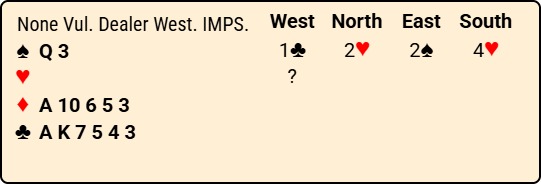
We start with a hand that produces no majority vote, and six different options are supported by panel members. However, they do have a clear favourite, although there are strong feelings in both directions about the meaning of that choice. Indeed, this sequence throws up a number of important questions for regular partnerships to discuss: Is Pass forcing? What is Double? What is 4NT?
Amongst competition entrants, two options garner around a quarter of the votes, but each of those choices attracts only two panelists.
PAUL MARSTON: 4♠. Trying to anchor a game.
PIERRE SCHMIDT & JOANNA ZOCHOWSKA: 4♠. For us, 4NT would be minors (with longer clubs) and that would also give a fair image of the hand. That was my preference, but I can agree with Joanna's feeling that 4♠ is the more pragmatic choice.
Rob and the French are in opposite camps as to the meaning of 4NT.
ROB BRADY: Dbl. Takeout. For those wondering, 4NT is keycard in spades, so we don't have that bid available. Playing pass as forcing sounds like a useful agreement when both opponents pre-empt but, absent that agreement, this is flexible for now. Our follow-up decision may be more interesting. I'll go low and pass if partner bids 4♠, while I plan to raise 5m to six. We might also win big if partner has something like Axxxx/KQxx/Kx/xx by collecting a number on defence.
BARNET SHENKIN: Dbl. Partner should work out that I do not have many hearts.
Jill thinks Pass is forcing…
JILL MEYERS: Pass. I hate this hand. I don't want to bid 4NT because, undiscussed, the meaning is uncertain. I think pass is forcing: if partner doubles, I will bid 4NT, which is stronger than bidding 4NT immediately, so partner should play me for minors and extras. If partner bids 4♠, I can then key-card, so pass provides flexibility.
But are we sure it is forcing?
LARRY COHEN: 4NT. If I were sure Pass was forcing, I might prefer that (allowing 4♠ from partner). This shows minors, with longer clubs.
SALLY BROCK: 4NT. For me, this is a slam try in the minors, not RKCB. Partner should expect this sort of shape in the minors.
HANOI RONDON: 4NT. This should be for the minors, with longer clubs. If partner rebids his spades, I'll raise to six.
Marty spells out what, for many partnerships, is an important general principle.
MARTY BERGEN: 4NT. Takeout! Against opponents in four of a major when we have no agreed trump suit, 4NT should ALWAYS be for takeout and not RKC. ‘Game before slam’ - choice of game is the number one priority when faced with a high-level pre-empt.
MATS NILSLAND: 4NT. Let’s start by getting partner to pick a minor. Then I will have to guess whether to raise.
DAVID BIRD: 4NT. It is surely more useful to play 4NT as showing a big two-suiter, rather than RKCB for spades. This should hint at 5-6 shape, here, because I bid clubs first. My plan on the next round is to show what a good guesser I am.
I think someone mixed something in with Liz’s Scottish water…
LIZ McGOWAN: 4NT. I assume partner's bid shows some tolerance for clubs... (It does? He can’t bid his spades with something like AKJxxxx/xxx/Kxx/none? MS) My 4NT now shows diamonds, longer clubs and tolerance for spades. Obviously!
The rest are willing to commit to slam…
ZIA MAHMOOD: 5NT. Some will say 4NT is take out, but I don’t think so, and Pass would be non-forcing. So, I’ll gamble on the level in the hope that we’ll find the right strain.
SIMON DE WIJS: 5NT. Tough. Let’s overbid a little and leave choosing the right slam to partner.
MIHIR SINGHAL: 5NT. Offering a choice of slam, hoping to keep all three possible strains in the picture.
ANDREW ROBSON: 5NT. Very tricky, as we know neither the strain nor the level. But, as ever, it's choosing the right strain that is most important. 5NT is really the only way to offer a choice of strains, and we just have to hope the level is about right!
Joey finds an alternative way of doing much the same thing.
JOEY SILVER: 5♦. I have too much hand NOT to bid at the five-level. Diamonds is a good way to start, and I’ll await partner's next move.
This hand provided mixed fortunes for English players in Katowice. On VuGraph in a Mixed Teams knockout match, one English West opted for 4♠. Partner had AKxxx/Qxx/KJ/Q10x, so that was a 10-IMP loss when the opponents were allowed an uncontested auction to 6♣ at the other table. In the Seniors events, Alan Mould doubled and collected +1100 for a smaller loss, but another English pair bid and made the grand for a big gain.
I would think that the 4NT bidders will be spared a guess on the next round, as partner will surely jump to 6♣ with such a suitable hand for the minors. Should East consider jumping to 7♣ over 5NT? It certainly has play, and declarer was likely to make on the lay of the cards at the table.
I have one more question for regular partnerships that the panel did not address – what is 5♥? Whichever you use, 4NT and 5NT effectively invite partner to choose a minor and, presumably, suggest 2-0-5-6, 1-1-5-6, 0-2-5-6 or even more extreme shapes. Here, might we not also like to include spades in the discussion? Would 5♥ do that, or is it just a slam try agreeing spades?
|
ACTION |
MARKS |
PANEL |
Competitors' |
|
4♥ |
10 |
8 |
35 |
|
3♥ |
8 |
4 |
24 |
|
3♠ |
7 |
3 |
20 |
|
4♣ |
6 |
1 |
5 |
|
5♣ |
6 |
1 |
3 |
|
3♣ |
0 |
0 |
9 |
|
Dbl |
0 |
0 |
2 |
|
4♠ |
0 |
0 |
2 |
Competition Entrant Average Score: 7.30
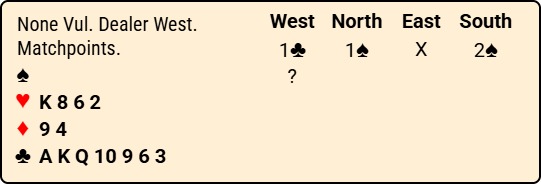
No majority vote from the panel, but a clear favourite nonetheless, and the competition entrants’ votes fairly well reflects those of the panel. The second-largest group on the panel are expecting to get a chance to describe their hand further…
ZIA MAHMOOD: 3♥. There’s a lot of bidding left on this hand. LHO will bid 3/4♠ and, when we hear partner’s action, we will know strain and level which, at the moment, is still murky. We might well still end in clubs.
JILL MEYERS: 3♥. I don't think it is going to go all pass, so I will have another chance. If this were IMPs, I would bid 5♣.
HANOI RONDON: 3♥. This hand is probably a bit strong for 3♥, but the auction is not going to end here. I'll show my clubs on the next turn, completing the picture of my hand.
Liz is the only one willing to defend in the right circumstances.
LIZ McGOWAN: 3♥. Softly, softly... 4♥ will surely attract 4♠, and I will not be comfortable if partner doubles that. If they bid 4♠ over 3♥ and partner doubles, I can pass happily. If there is no double I shall bid 4♣/5♣.
The next group starts with a cue bid.
MIHIR SINGHAL: 3♠. I'll start by establishing a force, intending to bid on over 3NT.
MATS NILSLAND: 3♠. This is enough for now.
SIMON DE WIJS: 3♠. Spade shortage with heart support.
Andrew and Simon are clearly on different wavelengths.
ANDREW ROBSON: 4♥. I don't see that much choice here – for me, 3♠ is not a heart-agreeing bid but, rather, a hand looking for 3NT. There may be more bidding: if the opponents bid 4♠, naturally I'll come again with 5♣.
DAVID BIRD: 4♥. This sequence must show an unbalanced hand. If East had bid 2♥ instead, promising a fifth heart, I would of course bid more strongly.
PAUL MARSTON: 4♥. Let's start with the game I think I can make.
A number tell us what they plan to do next, although Marty is the only one other than Liz to mention the possibility of a double from partner.
MARTY BERGEN: 4♥. After the opponents probably bid 4♠, I will bid 5♣ whether partner doubles or passes.
SALLY BROCK: 4♥. For now, but I will not defend 4♠.
BARNET SHENKIN: 4♥. I’ll continue with 5♣ if the opponents bid 4♠.
LARRY COHEN: 4♥. I have my hand on the 5♣ bid for the next round.
ROB BRADY: 4♥. I am planning to bid 5♣ over the likely 4♠ continuation from the opponents. We could miss a slam if this passes out, but there isn't a good way to invite. 3♠ doesn't show a heart fit, and forcing to the five-level could be a disaster if partner holds something like KJxxx/Qxxx/Qxx/x.
Does 4♣ have the same meaning as it would in an uncontested auction?
PIERRE SCHMIDT & JOANNA ZOCHOWSKA: 4♣. Without interference, these hearts would be a bit weak for 4♣ (showing six good clubs and four hearts, normally including two top honors), but here we have to prepare the future.
Joey is getting there quicker than everyone else…
JOEY SILVER: 5♣. Clubs and hearts are equal colours in the face of the villain's next bid of 4♠, so I might as well get to what I believe will be our best five-level contract before N/S can bid out.
Like the panel, West players at the table mostly bid 3♥, 4♥ or 3♠. Partner had only Jxxx/A10xx/AKQx/x, but 6♥ is still a decent proposition, and made easily with both round suits breaking 3-2. No one got to slam after West bid 3♥ but, knowing partner has short spades, some Easts did advance after a jump to 4♥. What happens after 3♠ is less clear.
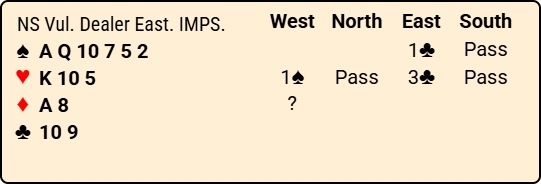
|
ACTION |
MARKS |
PANEL |
Competitors' |
|
3♠ |
10 |
8 |
28 |
|
4♣ |
8 |
4 |
2 |
|
3♦ |
7 |
3 |
19 |
|
3♥ |
6 |
1 |
7 |
|
4NT |
4 |
0 |
3 |
|
3NT |
2 |
0 |
33 |
|
4♠ |
2 |
0 |
3 |
|
5♣ |
2 |
0 |
1 |
|
Pass |
0 |
0 |
1 |
|
4♦ |
0 |
0 |
1 |
Competition Entrant Average Score: 5.57
It’s not often that I disagree strongly with most of the panel, but I guess that demonstrates what a difficult game bridge can be. Indeed, when selecting the hands for this set, I almost left this one out as I was sure that the panel would produce a huge majority vote for 3♦. What do I know?
Instead, we have a close-run thing between two options. I believe in democracy, so the marking reflects the panel’s views although, respectfully, I think the two largest factions are both wrong.
The panel here is essentially split into two camps: those who immediately support clubs, and those who want to keep spades in play. Competition entrants are also divided into three main groups: one collects top marks, the largest group opts for a choice not a single panelist mentioned, and one agrees with me.
Let’s start with those panelists who support partner’s clubs immediately.
MARTY BERGEN: 4♣. I am on my way to slam. Partner jumping to 3♣ without the ♣10-9 makes me very optimistic.
ZIA MAHMOOD: 4♣. Simple problem, as 5♣ will be an easy make and slam is likely.
Can partner not have something like KJ/QJx/Kx/AQxxxx? Slam in clubs is almost no play, and we would surely prefer to play in 4♠ (or even 6♠) rather than 5♣?
DAVID BIRD: 4♣. Partner will expect some top cards when I bypass 3NT.
Yes, but might he also not expect better clubs and, perhaps, shorter spades?
PIERRE SCHMIDT & JOANNA ZOCHOWSKA: 4♣. We play 3♣ as showing a seven-card suit and around 13-15 HCP. (With different hands, we can start with an artificial 2♦.) Anyhow, whatever 3♣ means, we are not far from slam.
LARRY COHEN: 4♣. I want to use RKC in clubs, which would be 4♦ (perhaps 4♣) for many experts, with 4NT as quantitative. To avoid disaster, I suppose I can raise clubs first and then hope someone uses RKC.
Let’s move on to the largest faction on the panel.
JILL MEYERS: 3♠. It’s forcing. Let’s see what he says.
LIZ McGOWAN: 3♠. Forcing after the jump rebid.
BARNET SHENKIN: 3♠.
ROB BRADY: 3♠. Please be unanimous. (Not even close 😊. MS) This is different than the auction 1♣-1♠-2♣, where a 2♠ rebid would be non-forcing. At the three-level, this is forcing. I'll pull 3NT to 4♣ as a mild slam try.
Yes, we all agree 3♠ is forcing, but how much are we likely to find out?
PAUL MARSTON: 3♠. Whether partner has one spade or two is important. This will flush it out.
Will it? Will he not just raise to 4♠ with something like K/AJx/xxx/AKQxxx?
SALLY BROCK: 3♠. This seems normal for now, although I suppose it might fix partner if he is short in spades and does not have stoppers in both red suits. But, I am happy enough to continue with 4♦ if he bids 4♣.
Will he not continue with 4♠ with the hand you are afraid of?
ANDREW ROBSON: 3♠. ...and I’ll continue with 4♣ over 3NT. If I had to guess the final contract right now, I'd guess 6♣.
Mihir plans to bid on over a raise, but are we headed for the right slam?
MIHIR SINGHAL: 3♠. Forcing. Slam is certainly possible here, especially if partner has spade support. I will see what partner says and invite slam over a raise to 4♠.
Is this not likely to tell us far more about partner’s hand?
HANOI RONDON: 3♦. I want to hear from partner again before deciding which black suit to set for key-card.
If partner bids 3♠ over 3♦, he surely has J-x or K-x. And, if he is stuck with a singleton spade and an unstopped red suit, he can ’grope’ with 3♥.
JOEY SILVER: 3♦. I am not sure where I want to end up with this potentially strong hand, but a space-saving 3♦ seems to be a good start. What I do next will be the real problem. (No spoiler alert today, as I have no idea what I will do over my ox's next bid.)
SIMON DE WIJS: 3♦. Waiting for now. I am intending to bid 4♣ next. A direct 4♣ tends to show more clubs for me.
I think this is better than 3♠, but leaves partner less flexibility than 3♦.
MATS NILSLAND: 3♥. I expect (hope for) a preference with J-x or better in spades. Over 3NT, I will continue with 4♣.
In the VuGraph match I watched, one West bid 3♠ and passed when East raised to 4♠. At the other, West started with 3♦ and then bid a natural 4NT when East advanced with 3♥. Holding x/A/K10xx/AKJ87xx, East now jumped to the excellent 6♣. Other successful sequences are available.
Perhaps East should bid 3NT over 3♠ with that, and when you now advance with 4♣ you’ll be back on track. Those who bid on over a raise to 4♠ will do well to finish in the right slam.
I’m afraid the 3♦ bidders have to settle for 7 points and, I think, a moral victory.
|
ACTION |
MARKS |
PANEL |
Competitors' |
|
5♣ |
10 |
6 |
38 |
|
5♦ |
9 |
6 |
41 |
|
4NT |
8 |
4 |
5 |
|
6♣ |
6 |
1 |
4 |
|
Pass |
3 |
0 |
5 |
|
Dbl |
3 |
0 |
3 |
|
6♦ |
0 |
0 |
2 |
Competition Entrant Average Score: 8.38
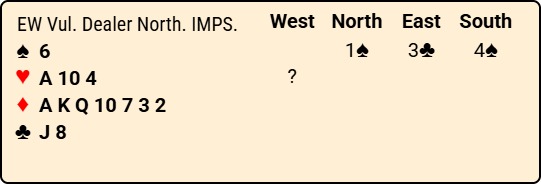
Most of the panel pick a minor at the five-level, and competition entrants are of similar mind. The 4NT bidders are mostly intending it as an invitational club raise, so I split the tie in favour of the club bidders.
PAUL MARSTON: 5♣. I am hoping to make 5♣. I am also not confident about beating 4♠.
MARTY BERGEN: 5♣. Our correct contract might be 5♣, 5♦, six of either minor (or even none of the above!) It is true that, even at these colors, my minimum requirements for the WJO are not as lofty as others.
DAVID BIRD: 5♣. His clubs might be of little use in a diamond contract. I am happy to play in clubs.
PIERRE SCHMIDT & JOANNA ZOCHOWSKA: 5♣. It is difficult to know which is best: 5♣ or 5♦. It depends on partner’s red-suit shape. We won't blame our colleagues who bid slam.
Simon previews the discussion to come later…
SIMON DE WIJS: 5♣. 4NT (slam try in clubs) is a close second. But, basically, that would be trying to bid slam on a finesse here. I don't like 4NT as pick-a-minor when one of us has already shown a long minor. Using it as a slam try is more useful.
ANDREW ROBSON: 5♣. A middle of the road action where we don't know who's making what. Yes, this could be swapping plus for minus, and I have a sneaking liking for doubling 4♠. However, that could be a complete disaster: they could make while we could be cold for 6♣. Probably 4NT should mean something here, but partner won't know what, so let's not torment him.
How about playing in our suit?
JILL MEYERS: 5♦. Am I missing something?
JOEY SILVER: 5♦. If East has solid clubs we rate to make a slam, (if we are allowed to play there). However, experience has taught me that partners never have the hand one is looking for, so I will settle for a tranquil 5♦, for now, that is.
SALLY BROCK: 5♦. It could be better to play in clubs, but how do I know? Slam could be on too, but partner’s clubs may well not be solid.
LIZ McGOWAN: 5♦. I expect more bidding from the opponents.
Yes, they may double!
LARRY COHEN: 5♦. This hand might not play well in clubs.
Nor, in diamonds! Zia knows the hand…
ZIA MAHMOOD: 5♦. I know the hand and this was a disaster, but I probably would have bid it at table… Doing the right thing was impossible at our table, as East did not bid 3♣, so it just went 1♠-Pass-4♠-5♦.
Only Barnet was willing to commit to the six-level…
BARNET SHENKIN: 6♣.
So, what about the 4NT bidders?
MATS NILSLAND: 4NT. I’m not sure what it means, but it sounds good.
That sounds like another question for regular partnerships to discuss.
ROB BRADY: 4NT. What is 4NT? Don't ask me! I doubt we will get an answer this month, but I'm sure I want to bid it. Candidates are: a) a good 5♣ bid; b) takeout; or c) keycard in clubs. I'm comfortable passing partner's 5♣ or 5♦ bid and, over anything else, I'll take a shot at 6♣. What does partner have for his unfavorable overcall here? ♣A-K-Q-x-x-x-x seems like a sensible candidate.
HANOI RONDON: 4NT. Just bidding 5♣ is too little. I hope partner understands that I have a great hand in support of his suit.
The general consensus seems to be that 4NT should be an invitational 5♣ bid.
MIHIR SINGHAL: 4NT. I want to be in slam here if partner has ♣-A-K-Q, which is not unlikely after the unfavorable pre-empt. As the only bid under 5♣, it makes sense for 4NT to be some sort of slam invite, and hopefully partner will be on the same page. If not, I guess we'll be in 6♣ anyway.

At the table at the world championships, partner had xx/Jxx/---/A109xxxxx. 4♠ is one down, but you can make 5♣. 5♦ is at least one down, losing a spade, a club and a diamond, and may also lose a heart too. In the VuGraph match I watched from Katowice, West bid 5♣ after this auction (+600). In the other room, as Zia commented, it went 1♠-Pass-4♠, so West obviously bid 5♦, and that was 13 IMPs out.
|
ACTION |
MARKS |
PANEL |
Competitors' |
|
3♥ |
10 |
11 |
44 |
|
4♣ |
7 |
5 |
33 |
|
3♣ |
5 |
1 |
11 |
|
2♠ |
3 |
0 |
8 |
|
Dbl |
0 |
0 |
2 |
|
Pass |
0 |
0 |
1 |
|
3♠ |
0 |
0 |
1 |
Competition Entrant Average Score: 7.50
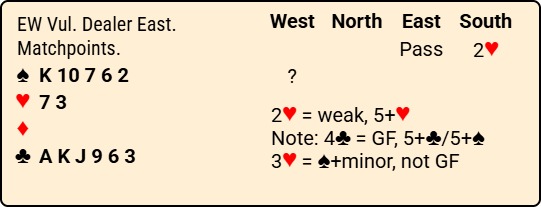
I included the notes so that there was no dispute about the meaning of 3♥, as I know some play it as asking for a stop. The result, perhaps, was that most concentrated on choosing between 3♥ and 4♣, ignoring the other two viable options (2♠/3♣). Like the majority of the panel, almost half of competition entrants decided this hand was not good enough for a game force. Only Marty elected to overcall in one of his suits…
MARTY BERGEN: 3♣. Much as I'd love to bid 4♣ (with the given conditions), I can't justify it on this hand.
The rest all decide to treat this hand as a two-suiter.
ANDREW ROBSON: 3♥. Much as we'd like to get our minor across immediately via 4♣, we just don't have the hand for it.
LIZ McGOWAN: 3♥. It would be nice to tell partner which minor I have, but the spades are too weak to force to game
ROB BRADY: 3♥. This hand is not strong enough for 4♣ but, opposite just ♠A-x-x, we have a reasonable chance at game so we have to try. Second choice 2♠.
PIERRE SCHMIDT & JOANNA ZOCHOWSKA: 3♥. The question is, “Is our hand good enough for a game forcing bid?” Our answer is "No."
BARNET SHENKIN/MIHIR SINGHAL: 3♥.
LARRY COHEN: 3♥. I would think that with 4♣ available to show this hand type, 3♥ would be stopper asking, but since you have given me a weak and a strong option to show a two-suiter, I'll go with the weaker one.
I agree that you can play 3♥ either way, but are you not much more likely to hold this type of hand rather than the one that just needs a spade stop for 3NT?
HANOI RONDON: 3♥. This helps to abbreviate the way to whichever black suit we belong in.
ZIA MAHMOOD: 3♥. Good or bad, it seems to work, although I prefer the opposite treatment, so this would show the stronger version chez moi. 3♣ is a reasonable alternative and might feel cleaner.
JILL MEYERS: 3♥. And, thank you for the bidding manual!!!
SALLY BROCK: 3♥. I’m not sure I always have that choice, but I’m glad I do here as I don’t really want to force to game with this hand.
The rest were prepared to commit to game…
PAUL MARSTON: 4♣. I cannot think of a reason not to show my hand. Waiting for Marc to enlighten me.
Not I, but see above perhaps.
DAVID BIRD: 4♣. Showing which minor I hold is a good enough excuse for being a point or so light.

JOEY SILVER: 4♣. Despite the five-loser hand, this is an overbid. However, the ability to identify both of my two suits in one bid persuades me to make that trade off, despite having to go to the four-level to do so.
MATS NILSLAND: 4♣. I think it’s better to show the minor, even though it is an overbid.
SIMON DE WIJS: 4♣. I will stretch to 4♣ now and put the brakes on next.
This hand from the final of the Russian Pairs championship produced a wide range of results. Partner had J9/Ax/Axxxxxx/xx and 4♠ makes eleven tricks, losing just two trumps. East had avoided opening with a diamond pre-empt, but getting to the top spot still proved too difficult when, at the table, West started with a 2♠ overcall.
Reaching either black-suit game scored above average. There is also a good chance of outscoring the theoretical top spot as, with South holding ♠Q-x-x and ♣Q-x, it takes a trump lead to beat 6♣! Perhaps getting that high is a stretch even for those who force to game with 4♣.
|
ACTION |
MARKS |
PANEL |
Competitors' |
|
4NT |
10 |
8 |
28 |
|
2NT |
9 |
8 |
31 |
|
5NT |
6 |
1 |
4 |
|
2♦ |
4 |
0 |
7 |
|
Dbl |
2 |
0 |
16 |
|
2♣ |
0 |
0 |
4 |
|
2♠ |
0 |
0 |
2 |
|
2♥ |
0 |
0 |
2 |
|
1NT |
0 |
0 |
1 |
|
3♣ |
0 |
0 |
1 |
|
3♦ |
0 |
0 |
1 |
|
4♠ |
0 |
0 |
1 |
|
5♣ |
0 |
0 |
1 |
Competition Entrant Average Score: 6.43
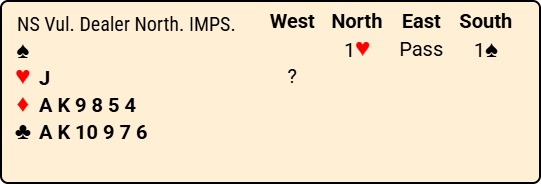
The panel is split between the two obvious options, and the competitors are of a very similar mind. The advantage of 2NT is that it gives you more chance of finding out if partner has enough to make slam playable, but also runs the risk of allowing opponents to find a fit and a profitable sacrifice when you get to 5m.
When Aaron Jones discussed this set with Rob Brady on his ‘Bradybot’ YouTube site, he raised a point I had not considered – the possibility that partner, with something like QJxxx/K109xx/xx/x, might choose to pass 2NT, but would never pass 4NT. That splits the tie for me, although the two largest groups both score well.
ANDREW ROBSON: 2NT. I could bid 4NT, but we'll learn more this way.
SIMON DE WIJS: 2NT. For me, this shows at least 6-5 in the minors. (We bid 2♥ with 5-5). I start low as I want to try to involve partner in bidding slam.
PAUL MARSTON: 2NT. Not 4NT. I prefer to give partner a chance to show some sign of life.
LIZ McGOWAN: 2NT. 4NT is more descriptive, but could be much weaker at this vulnerability. "I shall return".
ZIA MAHMOOD: 2NT. Start easy, finish high. I may still need to guess later.
HANOI RONDON: 2NT. I have the minors. I'll get to at least the five-level in whichever suit partner picks.
DAVID BIRD: 2NT. By bidding 2NT, I find out more about partner's hand. If I publicise my hand type, with such as 4NT, the opponents may find it easier to judge what to do at the five-level.
SALLY BROCK: 2NT. This seems okay for now. If I can get partner to show preference for a minor, I’ll probably drive slam and cross my fingers.
The rest all start higher…
JILL MEYERS: 4NT. No confusion over what it means on this one.
MATS NILSLAND: 4NT. Again 4NT. This month's theme?
MIHIR SINGHAL: 4NT. Minors, forcing the opponents to guess, especially as we are at favorable. Jumping might make it harder for our side to determine whether we have slam, but it's unlikely the opponents will let us have a constructive auction anyway.
BARNET SHENKIN: 4NT.
Ever the optimist…
LARRY COHEN: 4NT. I can always decide later if I want to bid slam. Also, I might get a chance to redouble 5m!

JOEY SILVER: 4NT. A very unusual no-trump! I plan to raise partner's response to slam, and will probably not sell short of the seven-level if pushed.
Marty wins “Comment of the Month” award for his astute observation.
MARTY BERGEN: 4NT. It amuses me that, at these colors, I'm making the same bid that I would have made if both of my A-Ks had been low cards!!
Rob is the only one to mention the third possibility…
ROB BRADY: 4NT. I'll pass 5m, but I plan to double if the opponents bid on, letting partner know this is our hand. 5NT is an interesting option too, as it will surely get an opponent to save at the six-level reasonably often.
…which was chosen by our French stars.
PIERRE SCHMIDT & JOANNA ZOCHOWSKA: 5NT. We selected this bid in two seconds, and then checked next with our favourite tool for simulations, which told us that we make a slam on 65% of the boards, so it seems OK.
At the table I watched in the Mixed Teams at the world championships in Katowice, West settled for a 2♦ overcall. When the auction continued 2♥-Pass-Pass, he then jumped to 5♣. Partner gave preference to 5♦, which was doubled. Partner produced Qxxxxx/KQxx/xxx/-- and, with trumps breaking 3-1 but clubs 4-3, that was +550. (‘Chapeau’ to Larry Cohen for remembering to redouble!)
In the replay, East came in with a jump to 2♠ over North’s 1♥ opening. West advanced with 3♦ and caught a raise to 4♦, so he decided his hand was good enough to bid slam. That was one down and a 12-IMP swing.
|
ACTION |
MARKS |
PANEL |
Competitors' |
|
Dbl |
10 |
13 |
29 |
|
Pass |
6 |
3 |
19 |
|
4♦ |
4 |
1 |
32 |
|
4♥ |
4 |
0 |
19 |
Competition Entrant Average Score: 6.08
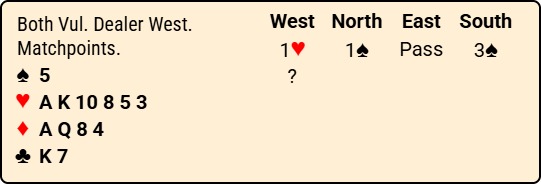
This hand produces the panel’s largest majority vote of the set. The competition entrants were much more divided. Almost a third collect top marks, but just over half choose to bid a game at the four-level, which was the choice of only a single panelist. Let’s start with the minority choices…
LIZ McGOWAN: 4♦. I am trying to help partner judge what to do over 4♠.
I have a feeling he won’t have to make that decision.
JOEY SILVER: Pass. I am too old and afraid to go all by myself to the four-level in the face of partner's silence after North's 1♠ overcall. This hand is just not good enough for that. (If I were to bid, it would be 4♦, to protect my ♣K.)
MIHIR SINGHAL: Pass. With partner passing, bidding on seems like too much.

PAUL MARSTON: Pass. Double is a gut reaction, but I have my doubts. I think there is a good case for passing. If partner has three hearts, he clearly has no points, and you will end up defending 4♠, and partner can say goodbye to his ♠Q. If partner has less than three hearts, you will probably concede a needless penalty, unless you get very lucky and buy five diamonds opposite.
The rest all followed the Pied Piper…
MATS NILSLAND: Dbl. What else?
MARTY BERGEN: Dbl. This is far more flexible than 4♥.
LARRY COHEN: Dbl. I have too much potential to go quietly. I am hoping partner doesn't bid 5♣.
ROB BRADY: Dbl. The higher the level, the more off-shape your takeout doubles can be. 4♥ is too committal and we can still bid it after 4m, showing a more flexible hand with six hearts.
SALLY BROCK: Dbl. I want to bring diamonds into the game without stressing them too much.
HANOI RONDON: Dbl. I want to make it possible to play in diamonds.
JILL MEYERS: Dbl. I will correct 4♣ to 4♦ or 4♥ (probably 4♦), and partner should play me for 6-4 in the red suits. With 5-5, I would just bid 4♦.
BARNET SHENKIN: Dbl.
DAVID BIRD: Dbl. There are plenty of minor-suit hands, for partner, where we can do well.
Andrew makes an accurate prediction.
ANDREW ROBSON: Dbl. I'd say this is a breather! Surely, a near-unanimous panel when there are still several possible contracts (including 3♠-doubled). There is still the question of whether partner's 3NT now would be natural or pick-a-minor: I'd opt for the latter and bid 4♦.
SIMON DE WIJS: Dbl. This feels normal. I will pull 4♣ to 4♦ to show this type of hand.
ZIA MAHMOOD: Dbl. Comfortable and in control.
PIERRE SCHMIDT & JOANNA ZOCHOWSKA: Dbl. We want to introduce the diamonds into the auction (if possible) without showing we have five cards in the suit.
The good news is that partner doesn’t have enough to bid 5♣ over a double. The bad news is that partner doesn’t have enough for you to make more than eight tricks in any denomination. Facing xx/Q/Jxxx/Q109xxx, the opponents could make 3♠, but you were -200 in anything at the four-level even if the opponents don’t double. A moral victory for Joey, Paul and Mihir on this one.
|
ACTION |
MARKS |
PANEL |
Competitors' |
|
4♥ |
10 |
6 |
18 |
|
4♠ |
9 |
5 |
25 |
|
3♣ |
7 |
3 |
5 |
|
4♣ |
5 |
1 |
6 |
|
5♣ |
5 |
1 |
3 |
|
5♥ |
5 |
1 |
<1 |
|
3♥ |
2 |
0 |
22 |
|
3♠ |
2 |
0 |
11 |
|
4♦ |
2 |
0 |
2 |
|
6♠ |
2 |
0 |
<1 |
|
2♠ |
0 |
0 |
6 |
|
4NT |
0 |
0 |
2 |
|
Dbl |
0 |
0 |
1 |
Competition Entrant Average Score: 5.55
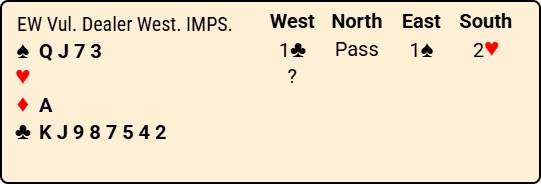
Having started with a hand on which the panel support six different choices, we finish with another. This time, though, they do not produce a clear favourite. The competition entrants are even more split, offering 13 choices, with the most popular agreeing with one of the panel’s top choices but the second largest group opting for a choice not mentioned by any panelist. Let’s start with those who rebid their clubs…
JOEY SILVER: 3♣. To fully understand partner's club fit with me, I have to emphasize my own clubs, so I take a chance. (Columbus did, and look what happened.) It is hard to imagine in this day and age, holding only one red card, that my three friends at the table will abandon me here. (I may well be by myself with this choice, BUT that does not make me wrong!)
ZIA MAHMOOD: 3♣. Eight-card suits are trumps unless we can get partner to rebid spades or we can give delayed support. We only have 11 HCP, so this auction is a long way from over. This type of hand does not need us to cramp the auction. I will be unimpressed by splinter bids or, God forbid, exclusion!
It sounds like Larry and Zia would make an interesting partnership 😊
HANOI RONDON: 3♣. Again, the auction is young and this will not end things. I prefer to support spades only if partner has at least five of them. The only eight-card fit I want to play in is clubs.
MIHIR SINGHAL: 4♣. Forcing with lots of clubs. While this hides the heart shortness and the spades, I don't like the alternatives much. 4♥ seems to suggest a stronger hand than this, which still needs a fair amount of black-suit help to make slam. 3♥ will cause the same rebid problem after partner's likely 3NT, but bids then will be even more ambiguous.
LIZ McGOWAN: 5♣. My hand is improved by partner's bid. I’ll give her the last guess over 5♥.
The rest show their spade support in some way…
DAVID BIRD: 4♠. Easily best, for both constructive and destructive reasons.
SALLY BROCK: 4♠. Anything could be right!
SIMON DE WIJS: 4♠. Weak and shapely. Ok, maybe I still have some shape left to tell. That will come on the next round.
PIERRE SCHMIDT & JOANNA ZOCHOWSKA: 4♠. If you have a bid to show an 8-4 distribution, well done. We don't. We are afraid we will have another problem on the next round of bidding.
MARTY BERGEN: 4♠. If East had passed, I would have imperfectly bid 4♣ (showing four spades with long clubs, and not necessarily a lot of HCP). After the 2♥ overcall, I'm afraid that 4♣ might/should just be natural. Splintering with 4♥ could work out well, but I think it's too likely to result in a bad slam.
Some are willing to take that risk.
PAUL MARSTON: 4♥. To me, this shows a spade fit with a heart shortage.
MATS NILSLAND: 4♥. Splinter, although I am not sure if my hand is worth it.
ROB BRADY: 4♥. Splinter. The value bid. A distant second choice is a *confident* leap to 6♠, which might cause our favorable opponents to take a phantom save, but this feels much too pushy without either top trump honor.
BARNET SHENKIN: 4♥.
JILL MEYERS: 4♥. This is very tricky. I guess I would bid 4♥ and hope partner appreciates the value of any club honor she has. Opposite as little as ♠K-x-x-x-x and the ♣A, my hand is great.
ANDREW ROBSON: 4♥. Because there are a lot of hearts out there and partner may well have four of them. He is therefore very likely to have a fifth spade, so spades should play okay.
It looks to me as if Larry has miscounted the number of key cards in his own hand…
LARRY COHEN: 5♥. Exclusion. Opposite one, I will bid 6♣. Opposite two, 7♠. The problem, of course, is that if we use 1430, Step 1 = 1, but what does partner do with 0?
I’m sure I read somewhere that irrespective of whether you normally play 1430 or 3041, you should always play 3041 in response to Exclusion, as you will often need the first step to be zero. Alternatively, you can play the same responses as Pre-empt Blackwood: 0, 1, 1+Q, 2, 2+Q.
At the table, partner had A10xxx/xx/Jxxx/A10. The ♠K was offside, but both 6♣ and 6♠ were still easy makes. I think the 4♥ bidders have the best chance of getting to the 20 HCP slam, and maybe Larry will recount to stop at the six-level.
With just under half the panel scoring in the 70s this month, we have an all-English tie at the top, Sally Brock and Andrew Robson both leading the way with 77/80. Completing the podium, are Rob Brady and David Bird, each with 73/80.
Thanks, as always, to all members of the panel.
See you all next month. Marc.
|
Sally BROCK |
4NT |
4♥ |
3♠ |
5♦ |
3♥ |
2NT |
Dbl |
4♠ |
77 |
|
Andrew ROBSON |
5NT |
4♥ |
3♠ |
5♣ |
3♥ |
2NT |
Dbl |
4♥ |
77 |
|
David BIRD |
4NT |
4♥ |
4♣ |
5♣ |
4♣ |
2NT |
Dbl |
4♠ |
73 |
|
Rob BRADY |
Dbl |
4♥ |
3♠ |
4NT |
3♥ |
4NT |
Dbl |
4♥ |
73 |
|
Marty BERGEN |
4NT |
4♥ |
4♣ |
5♣ |
3♣ |
4NT |
Dbl |
4♠ |
72 |
|
Larry COHEN |
4NT |
4♥ |
4♣ |
5♦ |
3♥ |
4NT |
Dbl |
5♥ |
72 |
|
Jill MEYERS |
Pass |
3♥ |
3♠ |
5♦ |
3♥ |
4NT |
Dbl |
4♥ |
72 |
|
Barnet SHENKIN |
Dbl |
4♥ |
3♠ |
6♣ |
3♥ |
4NT |
Dbl |
4♥ |
71 |
|
Zia MAHMOOD |
5NT |
3♥ |
4♣ |
5♦ |
3♥ |
2NT |
Dbl |
3♣ |
69 |
|
Hanoi RONDON |
4NT |
3♥ |
3♦ |
4NT |
3♥ |
2NT |
Dbl |
3♣ |
69 |
|
Paul MARSTON |
4♠ |
4♥ |
3♠ |
5♣ |
4♣ |
2NT |
Pass |
4♥ |
68 |
|
Mats NILSLAND |
4NT |
3♠ |
3♥ |
4NT |
4♣ |
4NT |
Dbl |
4♥ |
68 |
|
Simon DE WIJS |
5NT |
3♠ |
3♦ |
5♣ |
4♣ |
2NT |
Dbl |
4♠ |
67 |
|
Liz McGOWAN |
4NT |
3♥ |
3♠ |
5♦ |
3♥ |
2NT |
4♦ |
5♣ |
65 |
|
Pierre SCHMIDT & Joanna ZOCHOWSKA |
4♠ |
4♣ |
4♣ |
5♣ |
3♥ |
5NT |
Dbl |
4♠ |
65 |
|
Mihir SINGHAL |
5NT |
3♠ |
3♠ |
4NT |
3♥ |
4NT |
Pass |
4♣ |
64 |
|
Joey SILVER |
5♦ |
5♣ |
3♦ |
5♦ |
4♣ |
4NT |
Pass |
3♣ |
59 |
|
|
|
|
|
|
|
|
|
|
|
|
TOP SCORE |
4NT |
4♥ |
3♠ |
5♣ |
3♥ |
4NT |
Dbl |
4♥ |
|
|
HAND 1: |
4NT 10 |
5NT 8 |
5♦ 7 |
4♠ 6 |
Dbl/Pass/5♥ 5 |
5♣ 3 |
|
HAND 2: |
4♥ 10 |
3♥ 8 |
3♠ 7 |
4♣/5♣ 6 |
|
|
|
HAND 3: |
3♠ 10 |
4♣ 8 |
3♦ 7 |
3♥ 6 |
4NT 4 |
3NT/4♠/5♣ 2 |
|
HAND 4: |
5♣ 10 |
5♦ 9 |
4NT 8 |
6♣ 6 |
Pass/Dbl 3 |
|
|
HAND 5: |
3♥ 10 |
4♣ 7 |
3♣ 5 |
2♠ 3 |
|
|
|
HAND 6: |
4NT 10 |
2NT 9 |
5NT 6 |
2♦ 4 |
Dbl 2 |
|
|
HAND 7: |
Dbl 10 |
Pass 6 |
4♦/4♥ 4 |
|
|
|
|
HAND 8: |
4♥ 10 |
4♠ 9 |
3♣ 7 |
4♣/5♣/5♥ 5 |
3♥/3♠/4♦/6♠ 2 |
|
|
HAND 1: |
6.02 |
|
HAND 2: |
7.30 |
|
HAND 3: |
5.57 |
|
HAND 4: |
8.38 |
|
HAND 5: |
7.50 |
|
HAND 6: |
6.43 |
|
HAND 7: |
6.08 |
|
HAND 8: |
5.55 |

