
Contest conducted by Marc Smith
Welcome to the fifth set of 2026. The very difficult April set really put the cat amongst the pigeons on the annual competition leader-board, and we now have a 10-point gap between the leader and fourth place.
The biggest event in recent weeks was the USBC to select Open and Mixed teams to fill the USA1 slots at next year’s world championships. Playing with Bob Hamman in the Mixed Teams, Jill Meyers was the only member of the panel to make it to one of the finals, where they eventually succumbed to a team that included a trio of Rosenbergs. We’ll probably see some hands from those events next month.

This month’s guest panelists are the co-winners of the March competition. Tom Schlangen is a retired engineer from Mesa AZ. He began playing tournament bridge as a Minnesota teenager but paused to raise a family. He says, “You might see me at the tables again someday.” Originally from Charleston SC, Stephen Vogel has lived in Cincinnati for 40+ years, working as the CFO for Fortune 500 companies. He learned to play as a teenager and, like many others, put bridge on the back burner until retirement. He now enjoys playing both in-person and online, as well as mentoring others. Pat Shields started playing at school in Glasgow (as an alternative on sports’ afternoons), but it was at university in Cardiff that he was exposed to strong players and really learned to play. He represented Wales at Junior, Open and Senior levels before switching allegiance to England (where he now lives). He is also heavily engaged in bridge administration and teaching.
Hand 6 this month was sent to me by regular competition entrant Simon Moyston from England. Thanks to him. If you have a hand that you think would make an interesting problem for the panel to discuss, please send me the details.
The panel produces a majority on only two hands in this set. They do not offer such a huge range of options as they did last month, but they leave me with three hands that are impossible to mark (1, 4 and 5), and whatever I decide is bound to irritate some people. Apologies if that is you 😊
The most popular action chosen by the competition entrants scores ‘10’ on four of the eight hands, and voting with the largest group of competitors this month scores a creditable 67/80 (up from 59/80 in April). The average score this month is 56.54 (up from 53.60 on Set 26-04). Let’s see what the panel have to say about this month’s hands…
|
ACTION |
MARKS |
PANEL |
Competitors' |
|
5♠ |
10 |
6 |
8 |
|
7♦ |
9 |
3 |
2 |
|
5♦ |
7 |
5 |
41 |
|
6♦ |
6 |
3 |
14 |
|
6NT |
6 |
0 |
7 |
|
5NT |
4 |
2 |
2 |
|
4NT |
3 |
1 |
16 |
|
Pass |
0 |
0 |
4 |
|
5♣ |
0 |
0 |
2 |
|
6♣ |
0 |
0 |
2 |
|
7NT |
0 |
0 |
2 |
Competition Entrant Average Score: 5.67
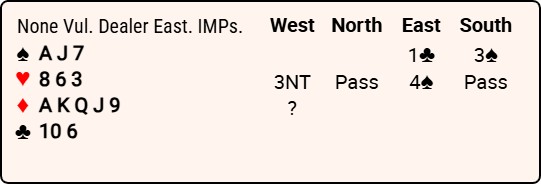
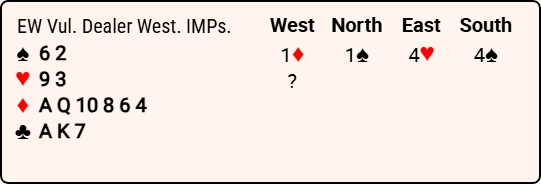
There is no majority vote from the panel, and they do little to solve the marker’s nightmare. For a start, they vote for 5♦, 6♦ and 7♦, and not everyone agrees about the meaning of 5♦. So, I have based the marking on the debate as well as the actual volume of support for each action.
The important question is, “What type of hand do we expect from partner for his 4♠ bid?” Can he have a one-suited hand with clubs? I would suggest not, as he could bid a forcing 4♣ with that. Is it not more likely that he has something like an 0-4-4-5 shape with A-K-A-K-Q in the round suits? Opposite such a hand, it seems clear that we can make 7♦, so I have elevated that in the marking.
In their discussion about the hands (search for ‘Bradybot’ on YouTube), Rob Brady and Aaron Jones suggest that 5♦ should be natural, as we might have bid 3NT on something like Kx/xxx/AKJxxx/xx. (5♥, though, would be control-showing, as we would have bid 4♥ rather than 3NT if we had the same hand with the red suits switched.) We start with those who choose 5♦.
STEPHEN VOGEL: 5♦. What does partner have? It could be a three-suiter, but would he bid this way with four small diamonds? With a round-suit two-suiter, I would expect a 4♥ rebid. Therefore, I think partner probably has a self-sufficient club suit with a spade void. I believe I need to show my good diamonds and let partner take it from there.
The rest all think this just shows a diamond control.
PAUL MARSTON: 5♦. I expect partner to have excellent clubs with a shortage in spades. Surely this is a control bid.
JOEY SILVER: 5♦. It sounds like East has solid clubs (although I am not willing to bet the house on it) and 4♠ is a self-agreeing cue bid. So, I will cue bid diamonds for now, and see what partner does next. I am heading towards a grand slam in a minor, but which one?
CATHY BALDYSZ: 5♦.
BRIAN GLUBOK: 5♦. I'd like to bid 6♦, but I fear that partner may have a one-suiter with clubs, something like ---/AKJx/xx/AQJ9xxx, so I'll show my control and try to stay out of his way.
Jill seems to be on a planet all of her own…
JILL MEYERS: 4NT. This could be very wrong, but I think RHO has some kind of twisty distributional hand. I hope they don't take the first four heart tricks!
If partner has bid this way with nothing in hearts, you should politely suggest he takes up backgammon.
DAVID BIRD: 6♦. I read 4♠ as showing spade shortage (often a void). He won't have a club single-suiter, or he would have rebid 4♣. If I bid 5♠ now, to show the ace opposite a possible singleton, this will not make it easy to find the best trump suit. The best I can do, it seems, is to show good diamonds.
Marty makes a number of predictions in this set, and this one seems likely to be accurate.
MARTY BERGEN: 6♦. Of course, we could be cold for seven.
LARRY COHEN: 6♦. It just jumps (pardon the pun) out at me. I don't see that 5♠ will accomplish anything.
Well, let’s hear from those who disagree with Larry’s assertion…
MIGUEL VILLAS-BOAS: 5♠. Invitational to the seven-level.
Do you expect him to accept with three low diamonds? And, if he bids 7♣, are you passing?
ROB BRADY: 5♠. What do bids mean? 4♠ is extras with long, strong clubs AND a spade control (shortness here, when we have the ace). Partner could have bid a forcing 4♣ without one. What do our bids mean? 4NT rejects the slam try, something like KQ10x/KJx/AQxxx/x. 5♣ also rejects, but wants to play clubs. 5♥ and 5♠ are cue bids agreeing clubs. What about 5♦? I'm worried this could be a hand which bid 3NT under pressure with a spade stopper and running diamonds. So, 5♠ looks clear for now. Fortunately, I wasn't asked what to do after partner’s expected 6♣. After all, 6♦ could be our best contract, if partner has something like --/KQJ/xxx/AKJ10xxx.
Is that really a 4♠ bid and not 4♣?
Andrew also comes up with an accurate prediction.
ANDREW ROBSON: 5♠. Then 6♦ over the likely 6♣. I think we have now painted a pretty good picture of our hand, although I somehow doubt we’ll get to a good grand, as partner will be worried about his diamond quality.
SOPHIA BALDYSZ: 5♠. Wow. I have all this and partner is bidding 4♠? It's just of matter of playing six or seven. I think 4NT would be negative, and I have a great hand, so I cue bid.
Zia is the only one who remembers the hand.
ZIA MAHMOOD: 5♠. A grand by any other name, is still a grand... 3NT was sort of forced with a guilty conscience, but now let’s go... (P.S. I do know the hand.)
Tom flirts with 7NT, which might be a trick short, whereas a spade ruff in partner’s hand might produce the thirteenth trick playing in diamonds.
TOM SCHLANGEN: 5♠. This confirms the spade ace and invites the grand. If partner can leap to 7♣ (solid suit), I'll convert to 7NT. Otherwise, I'll try 7♦, which is nearly cold opposite something like --/AKxx/xxx/AKQxxx, and is good opposite as little as -/AKxx/xx/AKxxxxx. Partner really cannot have less for his 4♠ bid.
5♠ leaves room for partner to advance with 5NT. What, though, is he supposed to do over…
LIZ McGOWAN: 5NT. Partner is presumably void in spades. She can choose which slam to bid!
ALAN MOULD: 5NT.
Does he bid 6♣, even though he has the minimum number of clubs he could have (five) after his 4♠ bid showing shortage. Do you expect him to bid 6♦ (or 7♦) on his three or four low?

I agree 100% with Patrick’s analysis of the problem. With only 3 votes from the 20 members of the panel, I didn’t think I could give 7♦ ‘10’, but I elevated it as much as I could.
PATRICK SHIELDS: 7♦. To bid like this, what can partner have except a void spade, AKQ-AK in high cards, and probably a 0445 shape?
PIERRE SCHMIDT & JOANNA ZOCHOWSKA: 7♦. East does not have a club one-suiter (he would bid 4♣), so his strong three-suiter should have not less than A-K-Q in both hearts and clubs (and we might still be safe with one queen or even one king missing).
HANOI RONDON: 7♦. Partner showed a great hand. We have a great suit and a first-round control. The grand slam should be on.
On this deal from a Vanderbilt quarter-final, one West jumped to 6♦, ending the auction. The other bid 5♦, then 7♦ when his partner continued with 5NT. Predictably, I think, East had x/AKQx/xxx/AKQxx, so there were multiple ways to make 7♦.
If not just jumping to 7♦, 5♠ looks like the best way forward? …5♠-5NT-6♦-7♦ perhaps (or just 7♦ over partner’s 5NT).
|
ACTION |
MARKS |
PANEL |
Competitors' |
|
Dbl |
10 |
14 |
40 |
|
4♥ |
6 |
4 |
35 |
|
4♣ |
4 |
1 |
11 |
|
4♦ |
4 |
1 |
2 |
|
5♣ |
4 |
0 |
3 |
|
Pass |
2 |
0 |
8 |
Competition Entrant Average Score: 6.90
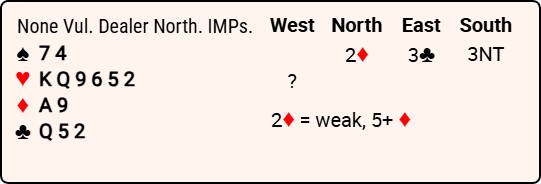
Only one panelist even mentioned what would have been the winning action on the actual deal (Pass), and one also chose the action taken against us at the table (4♣). The majority were clear about what to do now, although there was less clarity about how to continue, with many charging headlong into disaster. The other faction on the panel reached that sad place even faster. Three-quarters of competitors also opt for one of the two choices that attracted most of the panel.
SOPHIA BALDYSZ: 4♥. I just hope partner doesn't have a heart void.
LIZ McGOWAN: 4♥. This must show some sort of club fit, otherwise I would start with double.
Must it? You wouldn’t bid 4♥ now with something like xxx/AQJ10xxxx/x/x?
BRIAN GLUBOK: 4♥. My first inclination was to double 3NT - inevitably the bad guys would run to 4♦. I figured I could then bid 4♥, showing genuine strength along the way (and not just a fistful of hearts). The problem with that plan (like a lot of "prepared sequences") is that things may go awry - specifically, what if the opponents are in 5♦ by the time the bidding gets back to me? So, I'll just bid 4♥ now, as I would after (2♦)-3♣-(4♦)-?
PATRICK SHIELDS: 4♥. It would be strange for me to be sacrificing in this position, so partner should expect I am strong enough to make game. I could also give that message with double or 4♦ but then partner won't know what to do over their 5♦.
A couple preferred to support partner’s suit instead…
STEPHEN VOGEL: 4♣. South could have a running spade suit, a top club and perhaps another trick to make 3NT, so I cannot let him play there. I believe it is better to go with the known club fit as opposed to offering my heart suit.
MIGUEL VILLAS-BOAS: 4♦. If I double, the opponents will probably run to 4♦, and then what? I’d rather bid 4♦ now to show a good raise to 5♣.
The rest all choose to start with a Double. Some don’t tell us what they intend to do next…
PAUL MARSTON: Dbl. Good luck making 3NT.
JILL MEYERS: Dbl. I expect this to go down on a club lead.
You’re right, Jill, it would.
DAVID BIRD: Dbl. A double shows strength and leaves maximum space. You might bid 4♥ on longer hearts but without the ♦A.
HANOI RONDON: Dbl. I have had my share of tricky opponents, and I smell a rat with this 3NT, so I will double to smoke it out.
Joey is the only panelist to even mention passing…
JOEY SILVER: Dbl. If I didn't think I have a potential game to protect, I would just pass and collect 50's. (Of course, should South's bid be predicated on solid spades, I will abjectly seek partner's forgiveness.)
CATHY BALDYSZ/ALAN MOULD: Dbl.
Marty hedges his bets for what comes next…
MARTY BERGEN: Dbl. I definitely expect someone to run. After that, I will hope to do the right thing.
Most have a two-step strategy…
LARRY COHEN: Dbl. For now. After I smoke them out, I will likely bid 4♥ next. If by some chance they stick the double, I will be delighted.
ZIA MAHMOOD: Dbl. RHO may have long spades, but more likely he will just run to 4♦ (but it’s not a lead problem.) If I bid 4♥ now, that may sound like a weaker hand with long hearts. Let’s play along.
Tom sums up the majority view.
TOM SCHLANGEN: Dbl. Let’s first establish ownership of the hand (i.e. smoke out the joker on my right), then offer 4♥ as a potential contract after the expected retreat to 4♦. An immediate 4♥ bid should be weaker (i.e. just a fist full of hearts).

Andrew’s comment suggests that he thinks this route also shows a club fit.
ANDREW ROBSON: Dbl. Smoke South out, then offer 4♥ over 4♦. I think this is more flexible than the immediate 4♥ (second choice). I don’t want partner passing 4♥ with something like a 4-1-1-7 shape.
The French agree with that view, and thus should at least mitigate the disaster.
PIERRE SCHMIDT & JOANNA ZOCHOWSKA: Dbl. South is probably joking (if he is not, fine, let's collect the money). So, let's show a good hand first, rather than a 4♥ bid that could be a good seven-card suit and little else. When South bids 4♦, our 4♥ bid will then show points, hearts and certainly some support for clubs too.
Rob is one of the few heading for a plus score.
ROB BRADY: Dbl. Sometimes South has a real hand and North is the jokester in this auction, but we should first expose the psyche. Our subsequent Pass of the 4♦ continuation by South is forcing, so we will likely end up either defending 4♦-doubled or playing 5♣.
Partner did not have the most robust of overcalls, with KJx/x/KQx/J109xxx, and we can certainly question whether that is a sensible 3♣ bid, but that’s what he chose at the table against us, creating this problem for West.
Pass is the winning option, as 3NT goes four down (+200) on a club lead. If you double, South runs to 4♦, which is only one down (+100 if you manage to double and defend). Sadly, at the table against us, West bid 4♣, which South doubled for one down (-100) on his ♣A-K and two outside aces. For everyone bidding their long suit, you’d better hope that partner overrules you and runs to 5♣. Even though that is -300, it’s a bargain, as 4♥-doubled makes only five tricks. South has all of the missing high cards, so you lose three spades, two clubs, a club ruff and two trumps, and that is -1100. (I did say my 2♦ opening was weak.)
|
ACTION |
MARKS |
PANEL |
Competitors' |
|
1NT |
10 |
9 |
19 |
|
Dbl |
6 |
5 |
48 |
|
Pass |
6 |
3 |
8 |
|
2♣ |
4 |
2 |
6 |
|
2NT |
4 |
1 |
13 |
|
2♦ |
2 |
0 |
4 |
|
2♠ |
0 |
0 |
1 |
|
3♠ |
0 |
0 |
1 |
Competition Entrant Average Score: 6.10
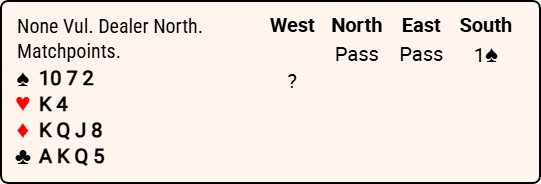
There is no majority vote on the panel, but they do produce a clear favourite. More than half of competitors opt for what is a clearly flawed minority choice.
PIERRE SCHMIDT & JOANNA ZOCHOWSKA: Pass. This is probably a part score deal. We want to be in, but feel like we are better positioned if we pass first. We hope to be able to show minors later. An immediate 2NT could do the job too.
JOEY SILVER: Pass. Making a takeout double with this sort of hand never works for me, so I will pass and await developments. Hopefully this will not turn into an opening lead problem at the one-level.
Although Double attracted more support on the panel than Pass, I awarded them the same mark as none of the doublers managed to provide a good answer to Miguel’s question.
MIGUEL VILLAS-BOAS: Pass. If I double, what on Earth can I do after a 2♥ response from my partner?
PAUL MARSTON: Dbl. Not 1NT, with such minor suit muscle. I will bid 2♠ over the likely 2♥ response.
Good luck going plus after that!
ZIA MAHMOOD: Dbl. I am not thrilled, but with Meckwell we do this I know. 2NT seems a bit more sick.
ALAN MOULD/CATHY BALDYSZ: Dbl.
And Sophia wins the ‘Optimist of the Month’ award…
SOPHIA BALDYSZ: Dbl. Let’s hope partner can bid 1NT.
The majority were more pragmatic.
LIZ McGOWAN: 1NT. I have to do something! Stoppers are overrated.
HANOI RONDON: 1NT. We're balanced and we have an 18-count. Are we missing something? What did you say? What's a stopper?
DAVID BIRD: 1NT. The 'Matchpoints' annotation pushes me towards 1NT. All other actions, including Pass, have larger faults attached to them.
LARRY COHEN: 1NT. I can't afford to settle for 50's here. If they run the spades, so be it.
Marty will no doubt be pleased that his prediction is wrong…
MARTY BERGEN: 1NT. Unhappily. I'm sure it will produce a bad panel score, but this has always worked well for me.
An astute observation from Andrew…
ANDREW ROBSON: 1NT. You don’t need a stopper in the opponent’s suit to be able to make 1NT. Nothing else appeals.
STEPHEN VOGEL: 1NT. I can’t double with only two hearts. Neither do 2♣ or 2NT appeal. I feel I need to get into the auction, so I choose to overcall a flawed 1NT.
ROB BRADY: 1NT. That ♠10 is a BIG card! Doubling off-shape with extras is asking for trouble. At these colors playing matchpoints, it's often a race to declare 1NT, so let's beat them to it 😊.
PATRICK SHIELDS: 1NT. I could pass but, unless they bid hearts and I can make a takeout double, I won't be able to enter this auction safely. This is less of a lie than the other options. When I believe we can make some contract, I don't want to settle for 50s.
A few mavericks were more creative…
JILL MEYERS: 2♣. I can't stand to pass this hand, and I hate all of the alternatives even more.
TOM SCHLANGEN: 2♣. This will enable partner to compete with a club fit or a six-card red suit (or a responsive double, if LHO raises spades). Of course, if partner can bid 2NT, I'll happily raise. At matchpoints, I think I need to compete, and the risk is lower now than later. At IMPs, I might still be thinking.
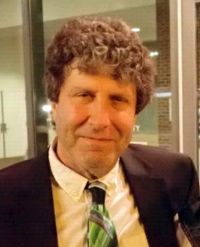
Brian wins this month’s “Comment of the Month” award, for this answer and also for his insightful observations on a number of the other problems. I have not forgotten what entertaining company Brian is when discussing hands long into the night after sessions.
BRIAN GLUBOK: 2NT. Minors. This is for demonstration purposes only - kids, don't try this at home. No one vulnerable at matchpoints is a different form of the game. Faint heart never won the maiden. Insert additional appropriate aphorism here.
At the table, partner had xxx/Axxx/xxx/10xx, so the defenders can take the first six tricks against 1NT (five spades and the ♦A), but you make the rest. If you pass, 1♠ ends the auction and you probably get +50. Double obviously fetches 2♥ from partner, after which there is no route to a plus score.
Having made the decision to Pass, Pierre Schmidt ran a computer simulation of this deal, which produced a number of worthwhile conclusions. One is that if you overcall 1NT, it will be rare that you play there when you have a better score available elsewhere. Partner will also be best placed to do the right thing if either opponent bids. The odds are also that South is unbalanced – given that he has enough high cards to make an opening bid, most of which will have to be in the majors, he is statistically likely to hold 6+ spades or at least 5-4 in the majors. I will leave you to conclude whether he is more likely to compete further with one of those shapes if you double (or bid a minor) than if you overcall 1NT. I’d suggest that 1NT is likely to discourage him with a 5-4-2-2 shape.
|
ACTION |
MARKS |
PANEL |
Competitors' |
|
5♥ |
10 |
7 |
41 |
|
Dbl |
8 |
8 |
23 |
|
Pass |
8 |
5 |
21 |
|
5♦ |
0 |
0 |
9 |
|
4NT |
0 |
0 |
2 |
|
5♣ |
0 |
0 |
2 |
|
6♥ |
0 |
0 |
1 |
Competition Entrant Average Score: 7.46
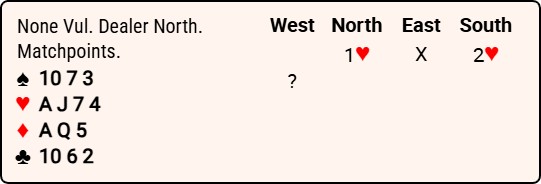
Again, no majority vote from the panel, which is almost split three ways. This is another tricky one to mark, so everyone who opts for one of the three options supported by the panel scores well.
It is significant that partner chose to bid 4♥, rather than a forcing 2♥. Presumably, something like x/KQJxxxxx/xx/xx would be a reasonable 4♥ bid. If he has that, where do we want to play the hand? Yes, 4♠ and 5♥ might both go one down, in which case defending will be a little better than playing. If either game is making, though, which seems likely, we want to bid on to 5♥. At IMPs, is it not clear that we should take the insurance?
What does it mean if we double now? Does that not specifically tell partner not to bid 5♥? We certainly cannot be sure that defending is right, so that is surely not the message we want to send. Whether partner will advance to 5♥ if we pass is unclear. Perhaps he will think he has already bid his hand.
The voting is close and I think the 5♥ bidders clearly have the best of the debate, so I have awarded them top marks (which will no doubt please the largest group of competitors). I also think that Pass is clearly better than double, but double attracted more panelists, so I have copped out and given them both the same mark. Sorry, but my largesse has all been used up, so I couldn’t bring myself to give the 5♦ bidders anything. Let’s see what the panelists have to say…
PAUL MARSTON: Pass. This seems obvious to me.
PATRICK SHIELDS: Pass. I could double but don't feel I need to. This is top end weak no-trump strength and partner already knows I have an opening bid. I am not sure what I'll do if partner doubles.
TOM SCHLANGEN: Pass. With good defense and no fit, I'd be tempted to double at matchpoints, but passing feels right at IMPs.
It’s hard to argue with Larry’s logic…
LARRY COHEN: Pass. Other than the sixth diamond, I have nothing special to say. I am leaving this up to partner.
ROB BRADY: Pass. I don't think we are in a force because the 4♥ bid could be made on hands with almost no defense. If this is passed out, we may miss a sizeable penalty: even +1100 is possible opposite something like x/AQJ10xxx/x/Qxxx. (Is that really a 4♥ bid rather than 2♥, though? MS). But at this form of scoring, doubling risks a double game swing, because partner will always pass, and that leans me in favor of giving partner a chance to bid 5♥ or 4NT. Given the form of scoring, partner will also be aware of this concern and, having heard us fail to double, he will compete more often, which looks correct from our perspective. At matchpoints, I'd wager on double being the clear winner.
Some waverers there, so what do the doublers have to say?
JILL MEYERS: Dbl. I am not committing to the five-level by myself.
HANOI RONDON: Dbl. I don't think we belong at the five-level.
STEPHEN VOGEL: Dbl. I have a minimum opening bid with two spades and no heart support. That sounds like a textbook double.
(Why isn’t it a textbook Pass?)
MARTY BERGEN: Dbl. This card-showing double is more flexible than 5♥.
Is it not exactly the opposite, telling partner to pass?
ALAN MOULD: Dbl.
ANDREW ROBSON: Dbl. This is not gilt-edged, but I have some good defence in the minors.
SOPHIA BALDYSZ: Dbl. The doubleton spade is the worst holding, as South could have bid 4♠ on a four-card suit. Partner could have bid 4♥ on as little as xx/KQJxxxx/xx/xx. Defending might be right, but could be wrong too. With three spades I would have supported hearts for sure.
From the comments, I wonder if some of the doublers think we are in a forcing pass situation.
PIERRE SCHMIDT & JOANNA ZOCHOWSKA: Dbl. This is a non-forcing situation, despite the vulnerability. Double shows top tricks (spade tricks are not likely in this auction) and we hope partner can judge. Of course, 5♥ would give the opponents the last decision. It’s a close choice.
And, finally…
MIGUEL VILLAS-BOAS: 5♥. I have good cards for my partner.
ZIA MAHMOOD: 5♥. My first thought was to pass, but the wish to force them to guess pushes me into bidding
LIZ McGOWAN: 5♥. I am probably trusting opponents too much at this vulnerability, but I am not confident that I can beat 4♠.
DAVID BIRD: 5♥. A vulnerable jump to 4♥ deserves respect. The pickings from 4♠ will probably not come close to +650.
An accurate prediction from Brian…
BRIAN GLUBOK: 5♥. We'll probably make it, and we may not be able to beat them in 4♠. My second choice is 4NT (and explain to partner later why this isn't Blackwood, but "obviously" shows either 6-4 in the minors, or 2-6 in the red suits).
CATHY BALDYSZ: 5♥.
JOEY SILVER: 5♥. If I thought partner would not take 5♣ as natural, that would be my bid,
On this deal from a match in the early rounds of the Vanderbilt, at one table West doubled. Partner had x/KQ109xxxx/Kxx/x and 4♠-doubled made eleven tricks when the diamond trick got away, thus -590 became -690. (South was 5-0-1-7). At the other table, West passed and East carried on to 5♥, which also made doubled (losing just a trick in each major), so +850. That’s a lot of IMPs! 5♦ goes down on a heart ruff, if they can find it.
|
ACTION |
MARKS |
PANEL |
Competitors' |
|
2NT |
10 |
8 |
50 |
|
Pass |
7 |
7 |
17 |
|
Dbl |
5 |
4 |
18 |
|
3NT |
4 |
1 |
11 |
|
2♠ |
2 |
0 |
2 |
|
3♦ |
0 |
0 |
1 |
|
3♥ |
0 |
0 |
1 |
Competition Entrant Average Score: 7.57
This may seem to be an unfair problem, as there was no notation telling you what 2NT would mean. Some panelists quite rightly assumed that 2NT would be natural playing with an unknown expert without detailed discussions, even though they normally play 2NT as either showing minors or Lebensohl. That seems right, as the basic premise for this competition is that your only agreements are ‘common sense bridge’ if not specifically detailed in the system notes.

We start with another inaccurate prediction…
ANDREW ROBSON: Pass. I expect a big majority for Pass with this flat defensive collection.
LIZ McGOWAN: Pass. This seems as likely a route to a plus score as the alternatives.
PAUL MARSTON: Pass. This looks like our best shot at going plus.
ALAN MOULD: Pass.
HANOI RONDON: Pass. No action seems adequate at this point. Let's hope partner can re-enter the bidding.
PATRICK SHIELDS: Pass. I see nowhere to go unless partner bids again, and then I will take a shot at 3NT.
ROB BRADY: Pass. 2NT is Lebensohl, so nothing looks good here. 4333 with extra values looks like defense rather than offense so, when partner balances double (as they are likely to do with almost all of their hands given their heart shortness), should I try to collect six tricks on defense or scramble with 2NT? Fortunately, I wasn't asked for a follow up decision: Thanks, Marc! My instincts say pass again and partner leads a trump, but this is probably wrong if partner has a five-card minor.
The Member for the 1970s gets the first word for the majority…
DAVID BIRD: 2NT. I see no reason whatsoever why this should not be natural. Lebensohl is close to useless when you can pass on a duff hand. A natural 2NT is an important club to have in your bag.
Larry and Zia clearly understand the ‘Conditions of Contest’.
LARRY COHEN: 2NT. In my book (literally and figuratively), this would be takeout for the minors, but I am guessing that it is natural without discussion, and therefore a reasonable choice.
ZIA MAHMOOD: 2NT. I actually play this as sort of Lebensohl but, as it’s not noted, I guess it’s natural here?
For different reasons, both Joey and Miguel are happy to have a natural 2NT available.
MIGUEL VILLAS-BOAS: 2NT. I am assuming that 2NT is natural. If 2NT either would show the minors or is Lebensohl, I would have to pass.
JOEY SILVER: 2NT. I don't like to hang partner when he shows initiative, so I will go slow. However, if 2NT would not be natural, I would speed up with 3NT.
MARTY BERGEN: 2NT. Natural. If I had minors, I would double.
That sounds right to me.
TOM SCHLANGEN: 2NT. Dick Melson told me to use less imagination and just bid what's right in front of my nose!
That seems like very sound advice.
JILL MEYERS: 2NT. Natural and invitational.
The doublers had a plethora of reasons for choosing that option…
STEPHEN VOGEL: Dbl. No-trump is not attractive with only one likely stopper. With values but no suit to bid, I cannot see a better course of action than a double.
PIERRE SCHMIDT & JOANNA ZOCHOWSKA: Dbl. We don't play 2NT as natural in this situation.
BRIAN GLUBOK: Dbl. I’ve gotta bid something. Second choice is 2♠. Wondering what 2NT would mean…
The Polish ladies came up with different solutions to not having a natural 2NT available…
CATHY BALDYSZ: Dbl.
SOPHIA BALDYSZ: 3NT. In my system, the only options are 3NT and Pass, and you know how I hate to pass.
Whether 2NT should be natural here is something that regular partnerships need to discuss and agree. When I held the hand at the table, 2NT would have been Lebensohl, so that was not an option. Partner had Qxxx/x/Jxxxx/AQJ, so a responsive double gets you to 3♦, which is your only route to a plus score. Passing concedes -110 and you can make only six tricks in no-trumps, so 2NT is -100.
|
ACTION |
MARKS |
PANEL |
Competitors' |
|
5♥ |
10 |
8 |
32 |
|
5♠ |
8 |
6 |
16 |
|
Dbl |
8 |
2 |
3 |
|
5NT |
8 |
0 |
3 |
|
6♥ |
6 |
3 |
33 |
|
4NT |
6 |
1 |
9 |
|
5♦ |
0 |
0 |
1 |
|
6NT |
0 |
0 |
1 |
|
6♦ |
0 |
0 |
1 |
|
7NT |
0 |
0 |
1 |
Competition Entrant Average Score: 7.48
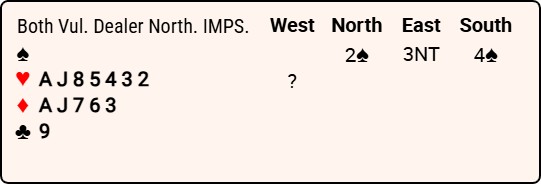
This is a very tricky hand, and I think the case for taking a sure plus score by doubling rather than taking a stab into the unknown at a high level has considerable merit. After all, the best contract for our side could be anything from 5♣/5♦/5♥ to a grand slam in any of those denominations. More than a third of competitors choose to take a stab at a small slam in our long suit, and they receive some support from the panel. At the table, that would have cost only 3 IMPs (-200 rather than -100) against the panel’s most popular choice. Let’s hear the arguments…
PAUL MARSTON: 4NT. I expect partner to have a string of clubs and a few spades, which does not leave much room for red cards.
That sounds very logical, but could also be the reasoning for this choice…
JILL MEYERS: Dbl. The hands this month are "damned if I do, damned if I don't." I have two aces, but no fit for partner’s presumed long clubs, so I’ll defend.
DAVID BIRD: Dbl. Partner would generally double first on a strong balanced hand, so I expect him to be short in one of the red suits. As on Hand 2, I will show strength and leave bidding space.
Most preferred to bid some number of hearts…
LIZ McGOWAN: 5♥. Anything could be making here, or not. There’s no room to explore, so I just have to guess. (I hope these problems are not all from the same match. My head already hurts.)
PIERRE SCHMIDT & JOANNA ZOCHOWSKA: 5♥. South might have bid 4♠ with a singleton or void somewhere and few HCP, so we can't discard the chance that partner has a really strong balanced hand such as Kx/Kx/KQxx/AKQJx. Of course, his hand can also be Q10x/x/KQ/AKQ10xxx. 4♠ is probably rather cheap, so let's bid, but with limited enthusiasm.
Stephen makes the same assumption as a number of panelists.
STEPHEN VOGEL: 5♥. Partner’s 3NT bid is likely be based on a long running club suit, a spade stopper and, perhaps, some scattered values. Even so, I prefer bidding my seven-card heart suit over other alternatives.

PATRICK SHIELDS: 5♥. It’s hard to imagine partner having 20+ HCP here against vulnerable opponents, so I will assume a good club suit. I cannot show a two-suiter and have partner leave me in diamonds with a doubleton. But passing is too much and doubling with a void is misleading to partner. That leaves 5♥.
BRIAN GLUBOK: 5♥. And then pass partner's correction to 6♣. As a BW-MSC panelist, Al Roth used to object to problems like this, insisting that he never saw such situations "in real life." Roth was dissembling - before he published his best-selling Roth-Stone System on Bidding (Bridge is a Partnership Game), he played a ton of Goulash bridge, so he had much more experience dealing with freaky 7-5 patterns than almost everyone else. (FYI “Goulash Bridge” is a variant where the cards are sorted in suits by each player, then dealt five at a time - popular in casual late-night games and also the variation of choice on commuter trains between New Haven CT and Grand Central Station in New York City.)
CATHY BALDYSZ/ALAN MOULD: 5♥.
ZIA MAHMOOD: 5♥. This is really impossible. Partner can have a stiff in a red suit. If I ask partner to pick a suit, he will try clubs for sure. Does he have a long club suit or a semi-balanced hand? I hope this will suggest a slam try. but it’s a murky area. The disparity of red suit length is also a problem. Perhaps I will survive this with a later diamond bid or a pass of 6♣.
Some are more optimistic.
SOPHIA BALDYSZ: 6♥. It looks like partner might have a long club suit and a spade stopper. I'm shooting a bit in the dark here.
TOM SCHLANGEN: 6♥. Yeah, the pre-empt has forced me to guess, but now it's their turn!
I have a feeling that South, with ♥K-Q-10-7, will ‘guess’ to defend (but undoubled, rather than risk pushing you into a making grand slam).
ROB BRADY: 6♥. If we're gambling, we may as well go big, right? It's worth noting that double by us wouldn't be penalty (we’re guaranteed to have short spades here). It is just cards and takeout oriented, although partner will often sit, given his expected strong spade holding.
The remaining faction choose to investigate, but are they going to pass when partner bids clubs or offer him a choice of red suits?
HANOI RONDON: 5♠. Let's find a suit for slam. I control spades.
LARRY COHEN: 5♠. I could just settle for 5NT, pick a slam, but starting with this gives us a better chance to reach seven something. It wouldn't shock me if 7♣ is the right spot! (opposite something like Kx/Kx/Qx/AKQJxxx).
ANDREW ROBSON: 5♠. I’ll show my first-round spade control, paving the way to a possible grand slam if partner has great red cards.
MIGUEL VILLAS-BOAS: 5♠. A difficult hand. After any bid from my partner, I plan on bidding 6♥.
JOEY SILVER: 5♠. Just biding my time. The problem will arise on the next round, as to the nature of partner's 3NT, points or solid clubs. Do I have the confidence to pass 6♣? Probably not. I'll just gamble that East has something in hearts. (Colour me conflicted)
We finish this one with an accurate prediction from Marty.
MARTY BERGEN: 5♠. We could be cold for a grand slam, but maybe just finding the right denomination will be enough to win the board.
It is easy to assume that partner is likely to hold long/strong clubs and a spade stopper for his 3NT bid, particularly given our hand. With a very strong balanced hand, he would usually start with a double and then bid 3NT next. However, there is one hand type on which he cannot risk starting with a double of 2♠ – when he has a singleton heart.
At the table, West tried 5NT and converted 6♣ to 6♦. Partner had Axx/x/KQxx/AKQJx, so 13 tricks made when North led his singleton heart. After a similar start at the other table, West played 5♥-1 for a 16-IMP swing. Clubs split 4-3, so you can make 6♣. You can also get +800 defending 4♠-doubled.
|
ACTION |
MARKS |
PANEL |
Competitors' |
|
5♠ |
10 |
15 |
76 |
|
Pass |
7 |
5 |
14 |
|
5♥ |
3 |
0 |
<1 |
|
6♠ |
3 |
0 |
1 |
|
Dbl |
2 |
0 |
8 |
Competition Entrant Average Score: 8.80
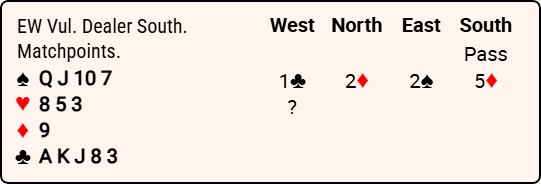
This one offers some respite for everyone, with just two options offered by the panel. Three-quarters of both the panel and competitors score top marks here. One question to be answered is whether a Pass would be forcing and, if so, what to do with that information. Those who choose to pass are split on both of those questions…
ZIA MAHMOOD: Pass. I will wait for partner to double, then pull. This is not a slam try, as pass is non-forcing.
PIERRE SCHMIDT & JOANNA ZOCHOWSKA: Pass. A non-forcing situation again but, at these colours, partner will very rarely pass in last position. We pass now but will bid 5♠ when (if) partner doubles, to show a hand weaker than an immediate 5♠. If you consider the situation as forcing, it would be the other way around.
Whilst some intend to remove partner’s expected double to 5♠, others plan on defending…
PATRICK SHIELDS: Pass. I have spade support but a minimum hand. Bidding now is guesswork. I don't know they are sacrificing, so we are not in a forcing pass position. When partner doubles, I will probably defend.
PAUL MARSTON: Pass. I expect partner knows I have short diamonds and therefore a few spades. Better to let him decide.

Rob’s reasoning seems right to me…
ROB BRADY: Pass. Are we in a forcing pass situation? Bridge logic dictates yes, even though partner’s 2♠ is not game-forcing. North has pre-empted and South has jumped to game on a passed hand. How is it possible that the hand belongs to them at the five-level? As a rule, it's wrong to bid 5-over-5 without a void in the enemy suit. We have great spade support of course, but this hand doesn't have any major surprises in terms of offensive power, and three small hearts is deadly. Sure, we may end up defending 5♦-doubled when we are cold for slam (e.g. AKxxx/Axx/xx/Qxx), but I'm willing to back my experience here, and pass with the diamond singleton. Given the forcing pass, partner still has a chance to make the last mistake.
The rest all choose to support spades immediately.
LIZ McGOWAN: 5♠. I guess this did not work at the table, but I am sure it is what I would do.
MIGUEL VILLAS-BOAS: 5♠. Vulnerable against not, it is surely right to bid at matchpoints, rather than taking what is likely to be an inadequate penalty. Some pairs will be allowed to play in 4♠, so defending loses to all of them.
BRIAN GLUBOK: 5♠. Don't get fancy with a forcing pass and then pulling to 5♠. KISS
JILL MEYERS: 5♠. Four trumps and a stiff diamond: this seems clear.
HANOI RONDON: 5♠. It's a better than normal fit. I control two suits. I think I need to help partner.
MARTY BERGEN: 5♠. This could be very wrong.
STEPHEN VOGEL: 5♠. My hand is much more offensive oriented that defensive. They might even make 5♦. Best to bid 5♠ confidently.
Those seem like particularly pessimistic views. Sophia’s summation seems more likely to be accurate.
SOPHIA BALDYSZ: 5♠. It would have to be unlucky for partner to go down in 5♠. It looks like we'll lose a diamond and maybe a heart. Partner has to have something for his forcing 2♠ bid.
DAVID BIRD: 5♠. I wish to show my spade support. To do this via a forcing pass would show a better hand.
JOEY SILVER: 5♠. Someone once told me that this is a bidder's game, and this looks like a good hand on which to test that theory.
ALAN MOULD/CATHY BALDYSZ: 5♠.
Tom takes on my role as class comedian with his comment…
TOM SCHLANGEN: 5♠. Partner could expect more, but my spade support is too good to suppress. Will this work because my hand is offensive or will partner say that my bid is offensive?
LARRY COHEN: 5♠. Pushed around yet again. With these spades (and short diamonds), I just have to do it.
ANDREW ROBSON: 5♠. Pushed and could backfire, but it’s only a one-level stretch.
Some of the 5♠ bidders were concerned that they were making a slight overbid, and it is hard to argue that we are not bidding enough on this fairly moderate collection, but that was how things turned out.
On this deal from the final of the Kay Platinum Pairs at the Nationals in St. Louis, East had AKxxx/AJx/xx/Qxx (where have we seen that hand before?), so there were 12 easy tricks in spades. Defending gets you a very poor score (+500) and 5♠ ended the auction at the table (+680).
This hand is clearly not worth it, but regular partnerships might discuss whether a 5♥ bid would be ‘Last Train’ in this auction? Assuming pass is forcing (and I think it clearly should be for the reasons Rob outlines above), then pass and pull to 5♠ would also show slam interest. Would either of those routes be enough to convince East to bid slam? Perhaps, with his fitting ♣Q, but maybe the hands just fit remarkably well and this one is unbiddable in practice.
|
ACTION |
MARKS |
PANEL |
Competitors' |
|
4♦ |
10 |
8 |
20 |
|
4♥ |
8 |
7 |
37 |
|
5♥ |
7 |
1 |
2 |
|
Pass |
5 |
4 |
28 |
|
6♥ |
3 |
0 |
2 |
|
4NT |
0 |
0 |
6 |
|
4♣ |
0 |
0 |
2 |
|
4♠ |
0 |
0 |
2 |
|
6NT |
0 |
0 |
1 |
Competition Entrant Average Score: 6.56
The panel offers primary support for three options, whilst almost two-thirds of competition entrants vote for the two least popular of those choices.
MARTY BERGEN: 4♥. An underbid but, if partner had slam interest or a flexible hand, he should have made a negative double or bid three of a minor.
HANOI RONDON: 4♥. I think this shows a better than minimum hand, and I can play this suit even with a singleton opposite.
DAVID BIRD: 4♥. It's close between 4♦ (more likely to get you to a slam, when that's right) and 4♥ (showing the great suit and avoiding partner interpreting 4♦ as 5-5 in the red suits).
BRIAN GLUBOK: 4♥. It would be reasonable to pass, but we can always say we bid out for the hundred honors.
Some readers may not understand Brian’s comment but, in our day, the best way to improve your game quickly was to play rubber bridge for stakes at which you could not really afford to lose!
CATHY BALDYSZ/ALAN MOULD: 4♥.
A little more adventurous…
LIZ McGOWAN: 5♥. “Bid slam with good controls please, partner.” This is not asking specifically for a spade control, as she has already shown that.
Miguel highlights an important reason for not choosing one of the alternative options…
MIGUEL VILLAS-BOAS: 4♥. I think 4♥ could be better than 3NT on a club lead.

STEPHEN VOGEL: Pass. Partner should have a double stopper in spades for his jump to 3NT, otherwise I would expect a negative double followed by a no-trump bid. Of course, clubs could be our weak point, but a heart game could be susceptible to a diamond ruff, so nothing is perfect. Nine tricks are easier to take than ten or eleven, ergo…
TOM SCHLANGEN: Pass. I think that the direct jump to 3NT shows two stoppers, which could make this contract safer than 4♥ (e.g. KQxx/Kx/Qxx/Qxxx, where 4♥ fails if the 2♠ bidder can lead a singleton and get a ruff or two).
SOPHIA BALDYSZ: Pass. A couple of contracts could be right, starting with 3NT. Other possibilities are 4♥, but also some slams. With an ace-less hand, it might be risky to look for something more, though.
One of us can’t count the number of aces we hold!
LARRY COHEN: Pass. Reluctantly. We are missing four keycards, and partner would need three of them to make slam reasonable, so I'll hope that going low is right.
The rest all choose to introduce their second suit.
JOEY SILVER: 4♦. If I need a heart finesse, it rates to be onside, so I bravely explore for slam.
JILL MEYERS: 4♦. I have a very good hand. We could have a slam, so let’s try to give partner a picture of our hand.
PAUL MARSTON: 4♦. I am hoping partner can cue bid 4♠.
PIERRE SCHMIDT & JOANNA ZOCHOWSKA: 4♦.
ANDREW ROBSON: 4♦. 4♥ seems so regressive with such good slam potential. I am a little worried that partner will raise to 5♦, and we’ll be in the lower-scoring game, but that’s less of a concern at IMPs. The chance of a good 6♦ is so great, I can’t resist it.
Both Patrick and Rob see this route as safe way to investigate potentially higher things.
PATRICK SHIELDS: 4♦. We could easily have a slam on. This gives partner the chance to sign off with a quacky hand, or to get excited if rich in key cards.
ROB BRADY: 4♦. 4NT is safe even opposite a terrible East hand such as AQxx/x/Axx/Qxxxx, and that is truly sub-minimum. We might also find a better strain than no-trump by bidding on. Even 7♦ could be excellent, opposite something like AJx/x/AQxxx/Axxx. I'll take a stab at it and give up if partner signs off in 4♥ or 4NT (4♠ would be forward-going in diamonds).
Zia sees this as just the first of more than one slam try.
ZIA MAHMOOD: 4♦. We are likely to end up in hearts, but this is both descriptive and a slam try. My options will be to just raise 4♥ to 5/6♥. If partner bids a regressive 4NT, I’ll bid 5♥ as a last slam try.
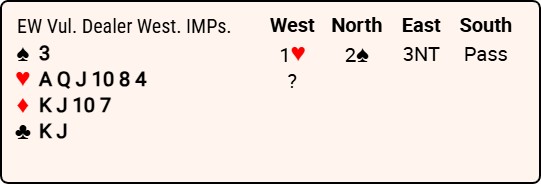
On this deal from the Camrose match between England and Wales, the auction began this way at both tables. The English West advanced with 4♥ and soon reached 6♥ opposite AKxx/Kx/Axxx/xxx. A winning diamond guess brought home the slam. The Welsh West passed 3NT and, when declarer misguessed on the club lead, that went one down.
On the lowest scoring set ever by the panel, we have a tie at the top with two players who have played in partnership many times, Zia Mahmood and Andrew Robson, both with 73/80. David Bird completes the podium with 72/80. With only six panelist returning a score in the 70s, is this another tough set for competition entrants? Perhaps, but I suspect a few will manage to outscore the entire panel this month.
The European Championships begin in Riga towards the end of June. I hope to report that one or more of the major events are won by teams including panel members, so Good Luck to everyone heading for Latvia.
Our thanks, as always, to all members of the panel for their time and effort.
See you all next month. Marc
|
Zia MAHMOOD |
5♠ |
Dbl |
Dbl |
5♥ |
2NT |
5♥ |
Pass |
4♦ |
73 |
|
Andrew ROBSON |
5♠ |
Dbl |
1NT |
Dbl |
Pass |
5♠ |
5♠ |
4♦ |
73 |
|
David BIRD |
6♦ |
Dbl |
1NT |
5♥ |
2NT |
Dbl |
5♠ |
4♥ |
72 |
|
Joey SILVER |
5♦ |
Dbl |
Pass |
5♥ |
2NT |
5♠ |
5♠ |
4♦ |
71 |
|
Marty BERGEN |
6♦ |
Dbl |
1NT |
Dbl |
2NT |
5♠ |
5♠ |
4♥ |
70 |
|
Hanoi RONDON |
7♦ |
Dbl |
1NT |
Dbl |
Pass |
5♠ |
5♠ |
4♥ |
70 |
|
Rob BRADY |
5♠ |
Dbl |
1NT |
Pass |
Pass |
6♥ |
Pass |
4♦ |
68 |
|
Larry COHEN |
6♦ |
Dbl |
1NT |
Pass |
2NT |
5♠ |
5♠ |
Pass |
67 |
|
Patrick SHIELDS |
7♦ |
4♥ |
1NT |
Pass |
Pass |
5♥ |
Pass |
4♦ |
67 |
|
Cathy BALDYSZ |
5♦ |
Dbl |
Dbl |
5♥ |
Dbl |
5♥ |
5♠ |
4♥ |
66 |
|
Miguel VILLAS-BOAS |
5♠ |
4♦ |
Pass |
5♥ |
2NT |
5♠ |
5♠ |
4♥ |
66 |
|
Pierre SCHMIDT & Joanna ZOCHOWSKA |
7♦ |
Dbl |
Pass |
Dbl |
Dbl |
5♥ |
Pass |
4♦ |
65 |
|
Liz McGOWAN |
5NT |
4♥ |
1NT |
5♥ |
Pass |
5♥ |
5♠ |
5♥ |
64 |
|
Jill MEYERS |
4NT |
Dbl |
2♣ |
Dbl |
2NT |
Dbl |
5♠ |
4♦ |
63 |
|
Alan MOULD |
5NT |
Dbl |
Dbl |
Dbl |
Pass |
5♥ |
5♠ |
4♥ |
63 |
|
Tom SCHLANGEN |
5♠ |
Dbl |
2♣ |
Pass |
2NT |
6♥ |
5♠ |
Pass |
63 |
|
Paul MARSTON |
5♦ |
Dbl |
Dbl |
Pass |
Pass |
4NT |
Pass |
4♦ |
61 |
|
Brian GLUBOK |
5♦ |
4♥ |
2NT |
5♥ |
Dbl |
5♥ |
5♠ |
4♥ |
60 |
|
Stephen VOGEL |
5♦ |
4♣ |
1NT |
Dbl |
Dbl |
5♥ |
5♠ |
Pass |
59 |
|
Sophia BALDYSZ |
5♠ |
4♥ |
Dbl |
Dbl |
3NT |
6♥ |
5♠ |
Pass |
55 |
|
|
|
|
|
|
|
|
|
|
|
|
TOP SCORE |
5♠ |
Dbl |
1NT |
5♥ |
2NT |
5♥ |
5♠ |
4♦ |
|
|
HAND 1: |
5♠ 10 |
7♦ 9 |
5♦ 7 |
6♦/6NT 6 |
5NT 4 |
4NT 3 |
|
HAND 2: |
Dbl 10 |
4♥ 6 |
4♣/4♦/5♣ 4 |
Pass 2 |
|
|
|
HAND 3: |
1NT 10 |
Pass/Dbl 6 |
2♣/2NT 4 |
2♦ 2 |
|
|
|
HAND 4: |
5♥ 10 |
Pass/Dbl 8 |
|
|
|
|
|
HAND 5: |
2NT 10 |
Pass 7 |
Dbl 5 |
3NT 4 |
2♠ 2 |
|
|
HAND 6: |
5♥ 10 |
Dbl/5♠/5NT 8 |
4NT/6♥ 6 |
|
|
|
|
HAND 7: |
5♠ 10 |
Pass 7 |
5♥/6♠ 3 |
Dbl 2 |
|
|
|
HAND 8: |
4♦ 10 |
4♥ 8 |
5♥ 7 |
Pass 5 |
6♥ 3 |
|
|
HAND 1: |
5.67 |
|
HAND 2: |
6.90 |
|
HAND 3: |
6.10 |
|
HAND 4: |
7.46 |
|
HAND 5: |
7.57 |
|
HAND 6: |
7.48 |
|
HAND 7: |
8.80 |
|
HAND 8: |
6.56 |

