
Contest conducted by Marc Smith
Welcome to the fourth set of 2026. We’ve started the year with three tough sets, which have seen only 5-6% of competitors scoring in the 70s. It is therefore impressive that 24 competitors have averaged 70/80 or higher on the three sets so far. Will this one prove to be any easier? We’ll soon find out…
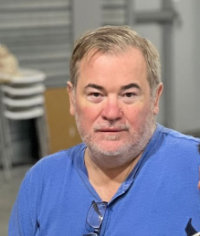
We are saddened to report the untimely death of a former member of this panel. Jacek “Pepsi” Pszczoła, a multiple world champion, was part of the international bridge community for many years. Born in Poland, he played under both the Polish and American flags. The whole bridge community mourns his passing after a devastating illness. R.I.P. Pepsi.
This month’s guest panelists are the co-winners of the February competition. Now in his 70s, Sweden’s Johan Bennet began playing serious bridge in 1976. Partnering Anders Wirgren, he was a member of the Swedish national team in the mid-1990s. He says, “I still play regularly, trying to maintain a decent standard.” Pavel Minevich is an IT specialist from Russia. He says, “I started to play bridge at university 25 years ago, and since then it has been my favourite hobby.”
Hand 3 this month was sent to me by regular competition entrant Bill March from England, and what an excellent problem it proved to be. Thanks to him. If you have a hand that you think would make an interesting problem for the panel to discuss, please send me the details.
I’m sure that many of you have been waiting with bated breath for my latest book, so I am pleased to advise that it is now available on Amazon (and no doubt other fine retailers). The e-version can be purchased from ebooksbridge.com or from masterpointpress.com.
The companion volume by the maestro himself, David Bird’s Playing and Defending Slams, is also available from the same outlets.
The panel produce a majority vote on three hands in this set, but on the remaining deals they are widely split. How widely? Well, on one of this month’s deals, they propose eight different solutions. On another two they are split seven ways, and on two more they support a mere five choices. I don’t think it is quite a record, but the panel vote for a total of 41 different actions on the eight deals. It sounds as if there will be plenty of high-scoring bids available on some hands, which must surely be good news for competition entrants.
However, the first sign that this might again be a tough set for competitors is that their most popular choice does not score ‘10’ on any of the hands on which the panel produces a majority vote. Indeed, their most popular action collects top marks on only two hands this month, and voting with the largest group of competitors scores only 59/80 (down from 65/80 in March). The average score this month is 53.60 (up from 51.61 on Set 26-03). Without more ado, let’s get to it…
|
ACTION |
MARKS |
PANEL |
Competitors' |
|
Pass |
10 |
9 |
30 |
|
4NT |
9 |
6 |
24 |
|
6♦ |
8 |
5 |
16 |
|
5♥ |
8 |
0 |
3 |
|
5♦ |
6 |
3 |
21 |
|
6♠ |
3 |
0 |
4 |
|
5NT |
3 |
0 |
1 |
|
5♠ |
0 |
0 |
1 |
Competition Entrant Average Score: 8.09
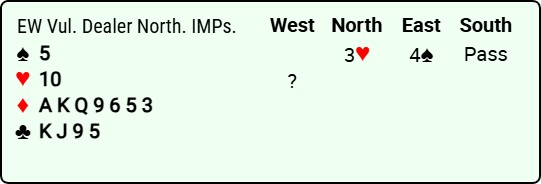
Perhaps the trickiest hand this month also proves to be one of the highest scoring, with a number of actions picking up close to top marks. The panel offer four different options (not including my choice when I held the hand at the table). Around a third of both panelists and competition entrants choose to let partner play game in his major…
MATS NILSLAND: Pass. When fixed, stay fixed.
PAUL MARSTON: Pass. I am not willing to give up a sure game for a possible slam.
LIZ McGOWAN: Pass. I was taught never to argue with partner's 4♠! There may be a better spot, but I think 5♦ would be a cue and 4NT is at best ambiguous.
P.-O. answers this one with the experience of someone who has been there before…
P.-O. SUNDELIN: Pass. If I bid any number of diamonds, partner will inevitably show up with a 10-3-0-0 shape.
SALLY BROCK: Pass. Of course, we could be missing an easy slam, but I can’t see a good route to it so I will take the conservative path.
JILL MEYERS: Pass. Partner could have AKJxxxxx and a queen. With a much better hand, she would have doubled first.
MIGUEL VILLAS-BOAS: Pass. My partner’s vulnerable jump to 4♠ can include the ♣Q, then 5♦ looks likely to be the winning bid, or he can be 3-7-1-2 without the ♣Q, when Pass will be best. The second case seems most likely.
BARNET SHENKIN: Pass. 5♦ sounds like a cue bid and it is not clear there is safety in 5♠. The choice for me is therefore between 6♦ and Pass. If partner is really strong, he should start with 4♥ or Double. His 4♠ overcall should show about 8+ tricks in spades. If he has solid spades and the ♣A, we will miss 6♠. Otherwise, we could easily miss 6♦. Good problem.
PIERRE SCHMIDT & JOANNA ZOCHOWSKA: Pass. Good or bad, one of our rules in competitive auctions, is that we can't play in a new suit bid for the first time at the five-level. So, 5♦ here would show diamond strength with (some) spade support, but not (necessarily) a playable suit. Of course, you can show us several East hands that make slam playable, but we can also find many where 10-11 tricks is the limit.
A few do not think 5♦ agrees spades…
ZIA MAHMOOD: 5♦. Nobody knows, including the panel, so I’ll just try bidding what’s in front of my nose.
CATHY BALDYSZ: 5♦.
LARRY COHEN: 5♦. Two ways to win (if either contract makes), and presumably only a small way to lose (if both contracts fail).
Some are prepared to commit to slam in their long suit…
DAVID BIRD: 6♦. It might not be there, but 4♠ shows a good hand so I can hardly risk stopping in game.
BRIAN GLUBOK: 6♦. This could be very wrong, but Pass and 4NT (RKC for spades?) also have their flaws. I think this hand is way too good to pass.
PAVEL MINEVICH: 6♦. Partner’s jump to 4♠ is not pre-emptive, so I hope he has two aces. I'm afraid that after 4NT I may not be able to get into diamonds and we'll land in an ugly 6/7♠.

SARTAJ HANS: 6♦. Our diamonds are semi-solid and there is no certainty that partner's spades are that great. For example, a hand like KQ10xxxx/Ax/xx/Ax is probably at the bottom end of the range for a jump to 4♠. Add the ♣Q and it would be a clear 4♠ bid.
ANDREW ROBSON: 6♦. This is my best guess, given that partner is supposed to have a pretty strong hand for his jump over a pre-empt. 5♦ and Pass may work better, but I think I have enough for 6♦ to make much of the time.
The rest prefer to ask for key cards, although their intentions thereafter vary…
HANOI RONDON: 4NT. I'm expecting partner's spades to be solid or semi-solid, so if he has three key cards I'll get us to 6♠.
ALAN MOULD: 4NT. Partner should have a proper hand for 4♠ (particularly at this vulnerability). It may be better to play in diamonds, but I cannot see a way of getting there, so I will just let Blackwood do the walking and hope for the best.
MARTY BERGEN: 4NT. Definitely not ideal, but I will follow with a diamond bid.
Is this an option, though? For many, Blackwood and then bidding 6♦ is a grand slam try asking for third-round diamond control. There are a few with similar intentions.
JOHAN BENNET: 4NT. A 4♠ overcall of a pre-empt should be a value bid. If partner responds 5♠, I will have to pass, expecting him to have AKQxxxxx(x) and we will be off two aces. Over 5♦, showing three key-cards, I will bid 6♦. He should only remove to 6♠ if his spades are solid opposite a singleton. With two spades, I would ask about the ♠Q.
Rob makes an accurate prediction, at least…
ROB BRADY: 4NT. Ugh! I'm sure the panel will prefer to pass... It is always a sensible strategy after an opponent’s pre-empt to try to go plus. However, I'd hate to catch partner with something like AQ10xxxx/Ax/x/Axx and miss out on a slam. Keycard isn't a perfect solution, but we can still play 5♠ opposite AKQxxxxx and out, as well as reach some slams that the passers miss. I'll play diamonds except for a 5♠ response. Anything is a gamble, so we may as well shoot for the biggest result if we guess right.
JOEY SILVER: 4NT. I hope we are not playing key-card Blackwood in this situation, but will bid it even if we are. I will bid 6♦/7♦ depending on how many aces I am sure partner holds.
I held this hand at the table, and I decided to put faith in partner’s suit by inviting slam with 5♥ (asking for good trumps, as 5♠ would ask for a heart control). Partner duly bid 6♠ with AQJ109xxxx/Ax/xx/--. He won the opening heart lead, ruffed a heart and lost just to the ♠K. 6♦ (or even 5♦) on a heart lead does not look that promising.
|
ACTION |
MARKS |
PANEL |
Competitors' |
|
1NT |
10 |
15 |
20 |
|
Pass |
7 |
6 |
31 |
|
Dbl |
5 |
2 |
47 |
|
2♣ |
0 |
0 |
1 |
|
2♦ |
0 |
0 |
1 |
|
2NT |
0 |
0 |
1 |
Competition Entrant Average Score: 6.52
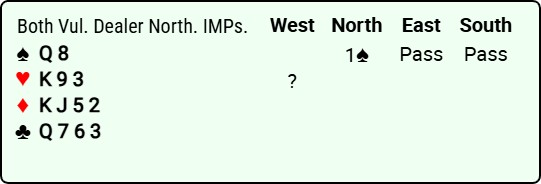
There are only three realistic choices on this one, and the panel produce their first big majority of the set. However, the competitors go in completely the opposite direction, with only a fifth of them picking up top marks. Let’s start with the panel’s minority choices…
HANOI RONDON: Pass. Mike Lawrence wrote in his Balancing book that we have to look at the majors when considering reopening. Give me an extra heart and I would do it, but I think this hand is better passed.
BRIAN GLUBOK: Pass. Due to the vulnerability. I think I am just short of either Double or 1NT, which are about the same. At any other vulnerability, I'd probably bid something. Tough problem.
SARTAJ HANS: Pass. I prefer a more aggressive style of doubling in the immediate seat (say Kxx/AQx/Axxx/Jxx) rather than bidding in the pass out with this sort of junk.
P.-O. SUNDELIN: Pass.
LARRY COHEN: Pass. Every bone in my matchpoint body wants to balance with 1NT, but I can't see that we have a game, so I might as well make this a deal where someone collects a small score.
ROB BRADY: Pass. A balancing 1NT has some appeal, but the lack of aces puts me off. Even when our partner has 13-14 and we have two spade stoppers, repeated spade leads might be enough to establish opener's suit before we can set up enough tricks to make game. Couple that with the chance that we may balance them into game with a favorable spade lie, and I'll go quietly this time.
The competitors’ most popular choice attracted little support from the panel.
PAVEL MINEVICH: Dbl, I don't like to let them play at the one-level. 1NT, with a well-known partner, is also an option.
MATS NILSLAND: Dbl. 1NT may be better, but IMO it shows a stronger hand.
Not that the majority are all overly enthusiastic about their choice.
ANDREW ROBSON: 1NT. Yuk. I hate my hand, but I also hate passing.
JILL MEYERS: 1NT. I don't love it, but I like it better than Pass or Double.
DAVID BIRD: 1NT. When all actions have a flaw, keep low. At least partner will have an approximate picture of my hand.
That this is the most popular choice comes as no surprise to one panelist…
ZIA MAHMOOD: 1NT. I expect this to be close to a unanimous choice, unless Helgemo is on the panel, as I know he plays 1NT as 15-17 even in this position
With a two-thirds majority, this is much closer than most predictions of overwhelming superiority come. Indeed, it is surprising how often a panelist’s predicted unanimous choice is not even the most popular option chosen by the panel.
MIGUEL VILLAS-BOAS: 1NT. I play this as 11-14. Double is my second option.
PAUL MARSTON: 1NT. Right-siding - 11-13 HCP.
LIZ McGOWAN: 1NT. Perhaps this risks getting too high, but who wants to defend 1♠?
SALLY BROCK: 1NT. I am not letting them off too easily, and I prefer 1NT to double on this minimum hand.
JOEY SILVER: 1NT. Intending to apologize to partner if disaster ensues. (Of course, I will do the same thing the next time this problem arises but, hopefully, the next time we will be playing pairs.)
BARNET SHENKIN/CATHY BALDYSZ: 1NT.
ALAN MOULD: 1NT. I prefer this to Double when I don't have four hearts and partner may well have spade length. I am quite close to Pass, though, as the opposition could still be cold for 4♥.
MARTY BERGEN: 1NT. For me, this is clearcut.
JOHAN BENNET: 1NT. To make sure of playing a NT contract from the right side. With my regular partner, 1NT does not promise anything in spades but, if he is bidding on, he can transfer to the opponents’ suit to ask about a stopper.
PIERRE SCHMIDT & JOANNA ZOCHOWSKA: 1NT. Our range is 10-14. Who cares about the spade stopper?
All four West players in the semi-final of the Open Teams at the European Winter Games faced this problem. In Prague, two passed, one bid 1NT and one Doubled. Partner had KJ8xx/AQxxx/109/x. 1♠ went one or two down (+100/200). 1NT was followed by 2♣-2NT-all pass and, although it can be beaten, it was allowed to make +120. Double was followed by 2♣-4♥-P-P-X and that was one down for -200, losing three aces and a spade ruff.
The main problem with double is that you will not be happy if anyone at the table bids 4♥! This looks like a moral victory for the passers.
|
ACTION |
MARKS |
PANEL |
Competitors' |
|
Pass |
10 |
5 |
4 |
|
Dbl |
10 |
5 |
11 |
|
4♠ |
8 |
5 |
47 |
|
5NT |
7 |
4 |
3 |
|
5♥ |
7 |
0 |
4 |
|
5♣ |
6 |
2 |
17 |
|
4NT |
5 |
1 |
9 |
|
6♠ |
5 |
1 |
2 |
|
5♠ |
3 |
0 |
1 |
|
6♣ |
3 |
0 |
1 |
Competition Entrant Average Score: 7.10
This is the second of three deals this month (1, 3 and 6) on which the panel provide little assistance with the marking, so a number of options score well. Indeed, everyone scores at least something.
Bidding 4♠ attracted nearly half of competition entrants, but top marks go the two actions that I think won the debate on the panel. One is to make a forcing pass and see what partner can contribute. The other seems to be the pragmatic choice, to take whatever penalty is on offer at equal vulnerability when it is unclear where you best contract is.
MATS NILSLAND: Dbl. Expert standard?
ALAN MOULD: Dbl. My flexible friend.
CATHY BALDYSZ: Dbl.
SALLY BROCK: Dbl. I might bid 4♠ if we were vulnerable, but not at love all.
SARTAJ HANS: Dbl. My partnership has a clear distinction between "duress game-force" actions (like 3♠ here) and "concrete game-force" actions like 1♦-(1♥)-3NT. In duress game force auctions, double is logically played as takeout. This would help get us to a 6-2 spade fit but also gives partner to option of defending 4♥-doubled. It reduces the chances of successfully playing 5♣ when that is the best contract, but we can't have everything when the opponents pre-empt.
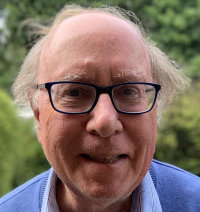
DAVID BIRD: Pass. Partner's 3♠ was forcing to game, so my pass here is clearly forcing. We could still blong in any of three suits, at game level or slam level, so I will pass the microphone to partner and hope that he is in a better position to make a decision.
The French include details of their methods: something for serious partnerships to consider, perhaps.
PIERRE SCHMIDT & JOANNA ZOCHOWSKA: Pass. Even at these colours, we are in a forcing pass situation. So, with no specific convention, we hope our partner will be better placed to judge the situation. FYI our system after a 3♥ pre-empt is: double with 4-5♠ (partner can bid 3♠ with three-card support), 3♠ denies spades, 3NT to play, 4♣ transfer to diamonds, 4♦ transfer to spades (at least six cards, and partner can bid 4♥ with a good hand, 4♠ with a minimum), 4♥ transfer to clubs, 4♠ both minors and 4NT natural.
LARRY COHEN: Pass. Forcing for sure, so this gives me the best of all options. Thankfully, you didn't ask me what I would do if partner doubles--maybe a problem for the future?
Miguel and Marty do tell us their intentions…
MIGUEL VILLAS-BOAS/MARTY BERGEN: Pass. This is clearly forcing. I intend to force to slam.
Everyone else bids on unilaterally, but there is little agreement as to exactly what to bid…
BRIAN GLUBOK: 4♠. It’s my turn to bid, right? 4♥ is practically a transfer to 4♠ in this sequence.
JILL MEYERS: 4♠. I am not getting us beyond the four-level on my own.
PAUL MARSTON: 4♠. I am not betting a sure game on a speculative slam.
BARNET SHENKIN: 4♠.
LIZ McGOWAN: 4♠. Partner really has to introduce a six-card spade suit here, even with limited values, so I will not punish her. She might have only five spades with outside values and we miss slam, but I like plus scores.
Only the Swedes are willing to introduce their second suit.
JOHAN BENNET: 5♣. If partner bids 5♦, I plan to continue with 5♠, which should show my 2-1-5-5 shape. With three spades, I would bid 4NT or 5♥ now. If partner passes 5♣. it could easily be high enough.
P.-O. SUNDELIN: 5♣.
Whilst Pavel decides that Blackwood will provide the answer.
PAVEL MINEVICH: 4NT. Two honours in spades, three aces, a heart control, and probably no wasted points in hearts: What else do I need for slam?
A few commit to slam…
JOEY SILVER: 6♠. I am at an inflexion point in the auction - either I bid the slam, or settle for game. The villains have put me in a very awkward spot. I can see no way at this high level to learn what I need from my ox for either game, slam, or grand, so I bid what I hope to make.
…but Joey was the only one of those who thinks he should pick the suit too.
HANOI RONDON: 5NT. Good old 'pick-up-a-slam'.
ROB BRADY: 5NT. This seems like the best way to get all three suits involved. Question for the panel: Should 5♥ be Exclusion or just a general slam try in spades?
I suspect the latter.
ANDREW ROBSON: 5NT. Slam rates to have a decent play, and 5NT (pick a slam) is the best way to reach the right one.
Only Zia mentioned the possibility that pass might not be forcing.
ZIA MAHMOOD: 5NT. I wish pass was forcing, but I’m not sure it is, and this is a great hand.
At the table, both the 3♥ bidder and partner had stretched – East had K10xxx/AKx/xxx/xx. After a heart lead against spades, entries are a problem, but a 3-3 trump break means you can scramble ten tricks. 5♦ is perhaps the safest game, but defending is the winning choice: 4♥-doubled brings in at least +800. The doublers and some of the passers are clear winners here, although those who bid 4♠ (or 5♣ if they intend to pass 5♦) will also manage to go plus.
|
ACTION |
MARKS |
PANEL |
Competitors' |
|
4NT |
10 |
12 |
10 |
|
4♠ |
7 |
7 |
19 |
|
4♥ |
6 |
1 |
22 |
|
4♣ |
6 |
2 |
5 |
|
6♦ |
4 |
0 |
3 |
|
Dbl |
4 |
1 |
9 |
|
5♦ |
2 |
0 |
19 |
|
4♦ |
0 |
0 |
11 |
Competition Entrant Average Score: 4.81
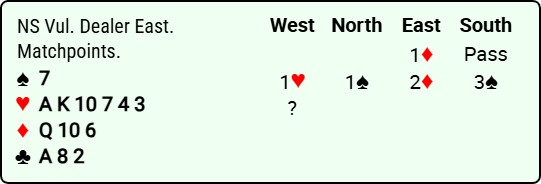
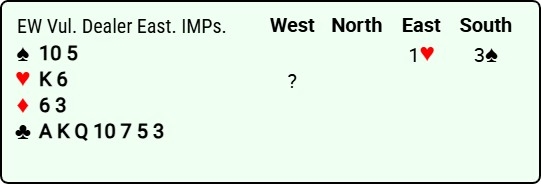
Playing matchpoints, I am a bit surprised that there is so little support for 4♥, with the likely +620/650 outscoring anyone who plays game in diamonds. However, the panel overwhelmingly consider slam chances good enough to forego the matchpoint advantage of playing in the major. The only question was how best to decide how many diamonds to bid, and it’s hard to argue with the logic of the majority.
HANOI RONDON: 4NT. Key card for diamonds.
ZIA MAHMOOD: 4NT. This must RKCB for diamonds. I can see 6♦/7♦ on the horizon.
JOEY SILVER: 4NT. I hope we are playing key-card Blackwood. I intend, of course, to bid at least 6♦, and will bid 7♦ if we have all the controls.
MARTY BERGEN: 4NT. A diamond slam is likely.
PAUL MARSTON: 4NT. Heading for slam in diamonds.
SALLY BROCK: 4NT. I like my hand for 6♦.
JOHAN BENNET: 4NT. Taking the simplest route. Partner did not make a support double, so I am happy to commit to diamonds to make sure of playing at the right level. My guess is that 6♦ was the right contract when the hand occurred.
BRIAN GLUBOK: 4NT. Key Card for diamonds. 6♦ figures to be either cold or a favorite. There is no point bidding it if we're off two key cards, though.
A surprisingly inaccurate prediction from David…
DAVID BIRD: 4NT. We don't have a 6-3 heart fit (no support double from East), so it's a question of 'How high in diamonds?' It seems likely that the readers will be at one with the panel.
Larry, Sartaj and Andrew all make similar points…
LARRY COHEN: 4NT. At first, I was voting for 4♠, but why not just get to the point? This is RKC in the last bid suit. Opposite two key cards, I will happily bid 6♦. Opposite fewer, I will live with being in the lower scoring game (and on a bad day, maybe 4♥ fails on a poor break).
SARTAJ HANS: 4NT. AK-sixth is the ideal side suit, so setting diamonds as trumps feels right. I might have tried a co-operative approach (4♠) at IMPs. However, at matchpoints, I don't want to play 5♦, so I might as well (more or less) force to slam.
ANDREW ROBSON: 4NT. RKCB for diamonds. This is clearer at IMPs, where playing 5♦ rather than 4♥ is no big deal. There are good enough chances of finding partner with ♦A-K for our bet to work, though.
The second-largest faction on the panel opt for the co-operative approach.
MIGUEL VILLAS-BOAS: 4♠. Showing a good raise in diamonds.
JILL MEYERS: 4♠. I have a great hand for partner.
ROB BRADY: 4♠. As little as xxx/xx/AKJxxx/xx makes slam quite good, and he will clearly have more than that, so we have to try, right? This might miss the top matchpoint spot of 6♥ if partner has something like xxx/Qx/AKxxxx/Qx, but how are we sensibly getting there? 4♥ is likely to be passed out with the opponents unfavorable. Last time I checked, +920 scores better than +480.
BARNET SHENKIN/P.-O. SUNDELIN: 4♠.
MATS NILSLAND: 4♠. This should agree diamonds, as 4♦ would be non-forcing. 4NT is an alternative.
PIERRE SCHMIDT & JOANNA ZOCHOWSKA: 4♠. Partner will very rarely have three hearts (he would make a support double of 1♠). OK, it's matchpoints, but we can't do everything: determine the right level for the final contract, and suggest playing in hearts if partner has Q-x in the suit.
A couple try to keep all balls in the air.
PAVEL MINEVICH: 4♣. Partner may think that it's natural, but I can always correct to diamonds later if he raises. Is 4NT clearly Blackwood for diamonds? Other options look worse.
LIZ McGOWAN: 4♣. I am trying to keep all options open. Partner can diagnose the singleton spade, and I surely have at least diamond tolerance, don’t I?
Alan suggests an alternative way to do the same thing, but I have to wonder how happy we will be if partner chooses to defend?
ALAN MOULD: Dbl. Again, flexibility.
Only Cathy is willing to stop in game to play in the major.
CATHY BALDYSZ: 4♥.
West settled for an extremely feeble jump to 5♦ at the VuGraph table I was watching. Partner had x/xx/AKJxxxx/Qxx, so 6♦ was an easy make with hearts 3-2. Are the 4♠ bidders all raising 5♦ to slam? I suspect so.
|
ACTION |
MARKS |
PANEL |
Competitors' |
|
Dbl |
10 |
14 |
15 |
|
4♣ |
7 |
9 |
65 |
|
5♣ |
5 |
0 |
10 |
|
4♥ |
2 |
0 |
7 |
|
Pass |
0 |
0 |
1 |
|
3NT |
0 |
0 |
1 |
|
4♠ |
0 |
0 |
1 |
Competition Entrant Average Score: 6.69
For the panel, this was a simple two-way choice, with a clear majority. Meanwhile, the competition entrants were also clear, with around two thirds opting for the panel’s second choice. Let’s start with the panelists who support the competitors’ favourite…
JOEY SILVER: 4♣. What's the problem? 4♣ seems automatic. My problem will come on the next round, unless partner takes control.
JILL MEYERS: 4♣. I am not bidding 3NT with two low spades, nor 4♥ with a doubleton, so I will bid what I have.
DAVID BIRD: 4♣. Surely, I must be allowed to bid a new suit after this start? I hope I don't have to read any comments claiming that '4♣ would obviously be a cue bid for hearts.'
Sadly, we don’t always get what we wish for, David.
MATS NILSLAND/CATHY BALDYSZ/PAVEL MINEVICH/P.-O. SUNDELIN: 4♣.
ALAN MOULD: 4♣. Maybe I should double again??!? But I just cannot bring myself not to bid seven solid. Imagine partner with something like Qxx/AQJxx/Qx/Jxx: they are likely to just Pass a double, and 3♠-doubled could make with an overtrick. (Mind you, anything we bid has four tricks off it, but it is not that likely to get doubled).
We finally get a hand on which double is the most popular choice, and you reject it, Alan!
BRIAN GLUBOK: 4♣. This can't be way wrong, and we may still find our way back to 4♥. Playing "Adjective Bridge", I prefer a "Thrump Double" (asking partner to bid 3NT on any hand with a spade stopper). That "Thrump Double" was either invented or popularized by Marty Bergen.
It is therefore no surprise to find Marty in the majority camp…
MARTY BERGEN: Dbl. This is a THRUMP double. Clearcut.
ROB BRADY: Dbl. Thrump! I'll defer to Marty Bergen on this one.
Horrifying David, some panelists do mention that the popular alternative is not even an option for them…
SALLY BROCK: Dbl. Me playing with me doesn’t have a choice, as 4♣ would agree hearts. Anyway, I want to stay below 3NT.
SARTAJ HANS: Dbl. The mainstream approach is to play 4♣ here as a constructive heart raise (and 4♠ as clubs). Even without that agreement, I prefer to let partner suggest either 3NT or 4♥ via a flexible double.
LARRY COHEN: Dbl. Let's see if I have a good partner or not. If I don't hear the hoped-for 3NT, life will go on. It is amusing that there aren't many experts left who can bid a natural 4♣ here.
A number had a clear reason for their choice…
BARNET SHENKIN: Dbl. Keeping 3NT in the picture.
LIZ McGOWAN: Dbl. Perhaps partner can bid 3NT? I hope she does not pass...
HANOI RONDON/MIGUEL VILLAS-BOAS/ANDREW ROBSON: Dbl. Let’s try to get to 3NT.
ZIA MAHMOOD: Dbl. I will feel good if partner bids 3NT. Anything else is scary, but as it’s a bidding challenge, I’ll try. Worst case scenario is a bollocking by the panel.
Not all are intending to pass 3NT.
JOHAN BENNET: Dbl. If partner bids 3NT, I can bid 4♣. If he persists with 4NT, I’ll pass. Opposite something like Kxx/Axxxxx/Ax/xx, 4NT may be our last making spot.
PAUL MARSTON: Dbl. I know it's weird to be doubling for takeout with this minor suit configuration, but I cannot see anything good coming from bidding 4♣.
Our French stars have a system for this eventuality (and most others too), and they provide something for regular partnerships to discuss.
PIERRE SCHMIDT & JOANNA ZOCHOWSKA: Dbl. Let's see if partner can bid 3NT with a spade stopper. But we would choose another route at the table, our system after 3♠ being: 4♣ showing good heart support, 4♦ transfer to clubs (so it would be our choice here, leaving open the possibility for the opener to bid 4♥ with a good suit or to suggest 4NT), 4♥ purely competitive, 4♠ showing diamonds and 4NT both minors.
When this deal occurred in the English Grand Masters Pairs (IMP-scored), West against us (and at a number of other tables) chose 4♥. The winning option was double, as partner had KQx/AQxxx/J109x/x, so 3NT was the only making game. Well done two-thirds of the panel.
|
ACTION |
MARKS |
PANEL |
Competitors' |
|
4NT |
10 |
7 |
13 |
|
3NT |
9 |
7 |
64 |
|
4♦ |
9 |
5 |
10 |
|
4♥ |
8 |
2 |
5 |
|
5NT |
6 |
2 |
1 |
|
3♠ |
0 |
0 |
4 |
|
Pass |
0 |
0 |
1 |
|
4♣ |
0 |
0 |
1 |
|
6NT |
0 |
0 |
1 |
Competition Entrant Average Score: 8.42
Again, the panel fails to make a decision. The competition entrants vote overwhelmingly for 3NT, but I split the tie against that choice as two-thirds of the panel did not think just bidding game was enough. We start with those who did support that action…
BRIAN GLUBOK: 3NT. We're heavy, but partner could easily have something like Qx/KJ98xx/Axx/Qx. Thought for the Day: It's okay to have an extra queen now and then. Thought for Tomorrow: There's merit in playing 1♠-2♥-3♣ as showing some extras, even playing 2/1 (who doesn't?)
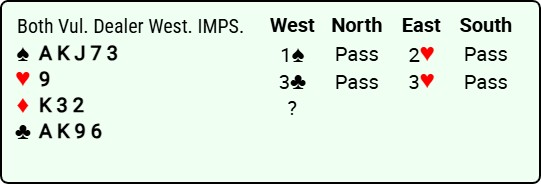
Brian raises an important point that, perhaps surprisingly, we haven’t addressed in all of the panel’s discussions. There are two versions of 2/1. If you play that rebidding your major (eg 1♠-2♥-2♠) shows a six-card suit, you have to rebid 2NT without stoppers and a second suit (3m after this start) even on the weakest of opening bids. I am with Brian, in the school that prefers 2NT to show stoppers and rebidding a new suit at the three-level to show some extras (even if not full reversing values). The default is then to rebid your five-card major when your hand doesn’t meet the criteria for any of the alternatives. There are plusses and minuses to both methods. It sounds like Miguel and Alan are on a similar wavelength…
MIGUEL VILLAS-BOAS: 3NT. My 3♣ showed extras, so now 3NT is ok.
ALAN MOULD: 3NT. Assuming 3♣ showed extras. Otherwise, presumably, I have to bid 4NT.
PIERRE SCHMIDT & JOANNA ZOCHOWSKA: 3NT. The priority now is to show a diamond stopper and no heart support. This hand is a little too strong for 3NT, but not strong enough for a natural 4NT.
BARNET SHENKIN: 3NT. This seems like the most flexible bid. Partner is still there.
PAVEL MINEVICH: 3NT. I need some extra values from partner for slam, so I hope he'll show them.
SALLY BROCK: 3NT. Keep low without a fit.
Some were willing to commit to playing in partner’s suit at this point.
LIZ McGOWAN: 4♥. I would prefer stronger diamonds for 3NT.
PAUL MARSTON: 4♥. I cannot see making 3NT without tricks from hearts, so let's play in partner’s suit.
The next faction agrees with that sentiment, but thinks 4♥ is not quite enough.
SARTAJ HANS: 4♦. A heart raise. I intend to make a very heavy pass if partner can do no more than bid 4♥.
JOHAN BENNET: 4♦. This is agreeing hearts. Partner didn’t bid a fourth-suit 3♦ to find out if I had a doubleton heart, so his suit should be playable facing a singleton. I expect something like xx/KQJ10xx/Axx/xx or thereabouts. If he has more than that, I expect him to bid something other than just 4♥.
JILL MEYERS: 4♦. I have great cards if partner has solid hearts.
HANOI RONDON: 4♦. I think they call it patterning it out. It's a little high, but I guess better than 5NT.
JOEY SILVER: 4♦. I now feel I have done my part, and that partner at this point has learned enough to take control.
The next group seem more comfortable in their choice than the 3NT bidders. Rob sums up the situation.
ROB BRADY: 4NT. Quantitative, this looks like a perfect description of our hand and values. It's worth mentioning that a 4♦ bid in this sequence should be a good heart raise, allowing us to take control with key-card later, so there is no ambiguity in a direct 4NT now.

MATS NILSLAND: 4NT. This hand is too good for 3NT or 4♥, and does not have enough heart support for 4♦.
DAVID BIRD: 4NT. I need 4NT here to show 'no fit and too good for 3NT'. To make a slam try in hearts, I would typically bid 4♦ now.
ZIA MAHMOOD: 4NT. I think 4♦ would agree hearts. This natural jump to 4NT seems to be about what the hand is worth.
CATHY BALDYSZ/MARTY BERGEN: 4NT. Quantitative.
LARRY COHEN: 4NT. Quantitative (unlike Hand 4) as I can bid 4♦ to agree hearts. Also, this is needed as quantitative (many experts would be able to use 4♠ Kickback to RKC in hearts).
A couple think the hand justifies committing to slam.
P.-O. SUNDELIN: 5NT. 4NT might be understood as RKCB. Not that the meaning of this (5NT) is 100% clear either.
Andrew is more confident in his partner’s ability to diagnose what is going on.
ANDREW ROBSON: 5NT. Pick a slam. Partner will deduce this shape (no 3♠ or 4♣ bid) and he may even infer the ♦K too (no 4♦ bid).
On this hand from the semi-final of the Mixed Teams at the European Winter Games, in the VuGraph match one West bid 3NT and the other 4♦. Partner had Q/KJ108xx/Axxx/Qx so you could make eleven tricks in either hearts or NT. The 4♦ bidder heard 4♥ from his partner and should have passed that. When he instead continued with 4NT, his partner decided (I think correctly) that it was Blackwood, and 6NT-1 was the result.
You need a natural 4NT here for a hand that is too good for 3NT but not good enough for 6NT. The panel are clearly of the opinion that the immediate 4NT is natural and, if you want to use Blackwood, you can agree hearts first with 4♦. Regular partnerships might like to check that they are on the same wavelength.
|
ACTION |
MARKS |
PANEL |
Competitors' |
|
4♣ |
10 |
9 |
31 |
|
6♠ |
7 |
4 |
8 |
|
5♠ |
7 |
3 |
7 |
|
5NT |
7 |
2 |
2 |
|
4♥ |
6 |
1 |
1 |
|
4NT |
6 |
1 |
15 |
|
6NT |
6 |
1 |
4 |
|
4♠ |
4 |
1 |
22 |
|
Pass |
2 |
0 |
9 |
|
4♦ |
0 |
0 |
1 |
|
5♣ |
0 |
0 |
1 |
Competition Entrant Average Score: 6.55
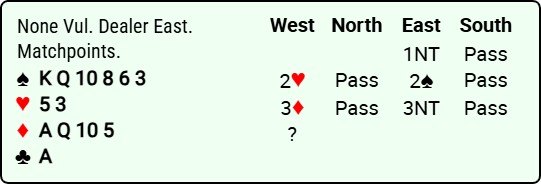
The panel again come up with seven options, although at least this time they also produce a clear front runner. Nearly a third of competitors collect top marks, but the second-largest group opt for what the panel collectively consider a huge underbid. Let’s start with a couple of mavericks…
ALAN MOULD: 4NT. I cannot think of anything more subtle.
ROB BRADY: 4♥. This really should show a good hand with 6-4, and I HATE putting partner in ambiguous situations, but they won't pass and are likely to make a waiting 4♠ bid, allowing us to keycard, as we wanted from the start. The alternatives (5NT, 6♠) are also flawed, so I'll take my chances with an expert partner to land on our feet later.
In his YouTube discussion of the hands, Rob and Aaron Jones were of the opinion that 4♣ might show 5-0-4-4 shape. Is this right, or would we not bid 3♣ at our second turn with that shape? The largest faction does not seem concerned with this possibility.
MARTY BERGEN: 4♣. Waiting. Despite partner's 3NT bid, slam is still likely.
HANOI RONDON: 4♣. Let's continue talking to see if we can reach 6♠ or 6NT.
MATS NILSLAND: 4♣. Trying to set spades as trumps before RKC.
MIGUEL VILLAS-BOAS: 4♣. With 5/5, I would continue would 4♦, so 4♣ seems to describe this hand well.
DAVID BIRD: 4♣. I would rebid diamonds with five of them, so this cue-bid paints a picture of 6-4 shape and slam values.
PAVEL MINEVICH/CATHY BALDYSZ: 4♣.

I think Johan wins the debate with the logic behind his choice.
JOHAN BENNET: 4♣. I can’t think of anything better. This shows slam-going values but with only four diamonds. Partner can now bid 4♦ with four-card support. I am hoping for something like Ax/AQx/KJxx/Q10xx, when 7♦ is an excellent spot, despite wasted values in hearts and clubs.
PIERRE SCHMIDT & JOANNA ZOCHOWSKA: 4♣. For many, 3♦ would show five cards (using a forcing 2NT to show hands with only four cards in a secondary suit). Here we will have to clarify later that we have six spades, with a small risk that the five-level is too high (opposite something like xx/KQJx/KJx/KQJx).
Of the rest, Liz is the only one willing to give partner a chance to stop in game.
LIZ McGOWAN: 4♠. This must be forward going - why did I bother to bid 3♦? I think 4♣ shows a shortage, which is not ideal with a singleton ace. The sixth spade is the most important information to get across.
Not sufficiently encouraging, say…
ANDREW ROBSON: 5♠. This seems like the value bid. Perhaps I should stay in no-trumps at matchpoints, but spades can easily make an extra trick.
SARTAJ HANS: 5♠. Slam could be awful, but we have too much power to not make a try.
BRIAN GLUBOK: 5♠. Let partner make the last mistake for the team. He'll appreciate it.
P.-O. SUNDELIN: 5♠.
…while those in the final two groups insist on slam.
JILL MEYERS: 6♠. Very scientific!
LARRY COHEN: 6♠. Even if partner has the dreaded two low spades, we are not doomed.
BARNET SHENKIN: 6♠.
JOEY SILVER: 6♠. I give up. Not seeing how to get to a grand slam intelligently, I will compromise and bid 6♠ unintelligently.
While Zia and Sally also keep diamonds in the picture.
ZIA MAHMOOD: 5NT. 6♠ means we can no longer play in diamonds. I think we can make slam, but we may need to play in the right strain.
SALLY BROCK: 5NT. I can’t see me either staying out of slam or bidding a grand, so I force to slam, suggesting that there are alternatives to 6NT.
Meanwhile, Paul goes for matchpoint gold by committing to slam in no-trumps.
PAUL MARSTON: 6NT. I cannot stop short of slam. On a good day we will not need the spades.
At the table, partner had Ax/AKxx/Jxx/KJ10x so both 6♠ and 6NT need either spades to come in or the diamond finesse. 6NT is where you want to play at matchpoints, but making +980 in spades is sure to score well above average too.
The 5♠ bidders will surely catch a raise. If you bid 4♣, does partner advance with 4♥, 4♠ or 4NT? Either way, you’ll have a second decision to make. Rob’s strange-looking 4♥ probably gets 4♠ from partner, and you can then Blackwood yourself to slam. Only 4♠ and perhaps 4NT look likely to languish in game.
|
ACTION |
MARKS |
PANEL |
Competitors' |
|
5♥ |
10 |
9 |
10 |
|
6♠ |
7 |
5 |
21 |
|
5NT |
7 |
3 |
3 |
|
4NT |
5 |
2 |
16 |
|
5♠ |
5 |
2 |
7 |
|
5♣ |
5 |
1 |
11 |
|
Pass |
4 |
1 |
26 |
|
5♦ |
0 |
0 |
4 |
|
6♣ |
0 |
0 |
1 |
Competition Entrant Average Score: 5.42
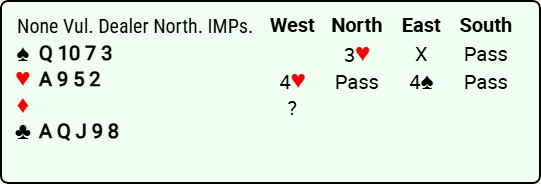
Again, seven possibilities suggested by the panel, but a clear favourite nonetheless. Only 10% of competition entrants pick up top marks on this one, with more than a quarter opting for a Pass of 4♠ that receives little support from the panel. We start with the mavericks…
MATS NILSLAND: Pass. I suspect this hand is not as good as it looks. The heart length is a warning sign and we have only a 4-4 spade fit. A shot at 6♣, anyone?
JOHAN BENNET: 5♣. This is dangerous hand. Hearts may be 4-7-1-1 around the table, and slam is far from certain. For example, AKxx/x/Kxxx/Kxxx is a good hand, but slam is still against the odds (needing clubs 2-2). If partner passes 5♣, it should be ok.
At least Sartaj’s choice is based on positive aspirations, but Blackwood with a void is always a dangerous move.
SARTAJ HANS: 4NT. There are days when partner shows three key cards and then owns up to the ♣K as well, so I might as well shoot for that.
PAUL MARSTON: 4NT. I will bid slam opposite two key cards - relying on the club finesse, if necessary.
A couple simply make an invitational spade raise…
PAVEL MINEVICH: 5♠.
JILL MEYERS: 5♠. I hope this is asking for good spades.
Is it, though?
Isn’t this the standard way to ask about trumps?
LIZ McGOWAN: 5♥. Partner can easily have a perfect minimum: AKJx/x/xxxxx/Kxx, but how can I describe this hand? I hope this says “bid six with good trumps” as 5♠ would ask for a heart control. I suspect a 4-4 fit, which may not play well on a 4-1 break, but pass seems too wet, even for me.
HANOI RONDON: 5♥. We need good spades for slam. I think this confirms controls in the other suits and asks about partner’s trump quality.
BRIAN GLUBOK: 5♥. I have slightly too much to pass. Similar to Hand 7, I’ll let partner guess whether to bid slam. I remember what Vic Mitchell said of Sam Stayman: "He always bids the three and the fives...." For more, visit www.wilsonovichbridge.com or substack.wbsbridge.com
ANDREW ROBSON: 5♥. Slam invite. This seems reasonable. My heart wants to pot 6♠, but my head stops me (and my righty waiting to double holding ♠A-K…)
ROB BRADY: 5♥. A slam try or better, unsuitable for keycard, with a heart control (first round strongly implied). I am not planning to let partner out in 5♠, although it could be the winner opposite such as Kxxx/x/KQJx/Kxxx.
LARRY COHEN/BARNET SHENKIN: 5♥.
ALAN MOULD: 5♥. I hate this hand! 4♠ could easily be the limit or we could be cold for seven. I will hedge. I don't want to risk 5♣ (though it ought to be a cue) so I will try 5♥. This just seems like a guess to me.
PIERRE SCHMIDT & JOANNA ZOCHOWSKA: 5♥. Again, the five-level may be too high (when you plan the play mentally, how do you get rid of these hearts when South is overuffing?) but we find the hand too "pure" to pass. We would like to send the message that clubs could be a better trump suit, but how? We won't criticize our partner if he does not get the message we try to send with 5♥.
The rest are all willing to take a shot at slam…
P.-O. SUNDELIN: 6♠. Lacking the methods to find out if partner holds AKJx/xx/Qxx/Kxxx or Jxxx/Kx/AKJx/10xx, I’ll take my best guess.
JOEY SILVER: 6♠. With potential distributional storms brewing, I will show my age, and go low.
CATHY BALDYSZ: 6♠.
SALLY BROCK: 6♠. Again, I can’t see a way to find out what I need to know, so I’ll pot something that should be sensible.
DAVID BIRD: 6♠. I don't see that 5♥ will tell the whole story of this hand. I will surrender to the pre-emption and raise to the small slam.
Although some wanted to keep open the possibility of playing in clubs…
MARTY BERGEN: 5NT. I am hoping to play in 6♣.
ZIA MAHMOOD: 5NT. We may belong in clubs, so I roll out the usual ‘pick a slam’.
MIGUEL VILLAS-BOAS: 5NT. I’m not sure if 5NT is asking for top spades to bid a grand or is pick a slam in this situation. It seems to me that if I was interested in a grand, I would start with 4NT to find partner’s key cards.
Partner had AJ9x/x/K10x/K10xxx. With the spade finesse wrong, 6♣ makes an easy twelve tricks. 6♠, though, might go down on a club ruff. “Chapeau” to Marty, Zia and Miguel, who reach the top spot.
We have a tie at the top this month, with French Mixed champions Pierre Schmidt/Joanna Zochowska and American legend Marty Bergen both scoring 76/80. The podium is completed by multiple English Women’s world champion Sally Brock and Brazilian stalwart Miguel Villas-Boas, both with 73/80.
With barely a third of the panel scoring in the 70s and a logjam in the mid-60s, anyone scoring more than around 65/80 can consider their performance an achievement this month.
Looking at the average scores on the various deals, it seems clear that competitors score best on those hands where the panel cannot agree. Curiously, it seems that the harder the problems are, the easier it is to score well on them.
As always, thanks to all members of the panel for taking the time to send their bids and comments. See you all next month. Marc.
|
Marty BERGEN |
4NT |
1NT |
Pass |
4NT |
Dbl |
4NT |
4♣ |
5NT |
76 |
|
Pierre SCHMIDT & Joanna ZOCHOWSKA |
Pass |
1NT |
Pass |
4♠ |
Dbl |
3NT |
4♣ |
5♥ |
76 |
|
Sally BROCK |
Pass |
1NT |
Dbl |
4NT |
Dbl |
3NT |
5NT |
6♠ |
73 |
|
Miguel VILLAS-BOAS |
Pass |
1NT |
Pass |
4♠ |
Dbl |
3NT |
4♣ |
5NT |
73 |
|
David BIRD |
6♦ |
1NT |
Pass |
4NT |
4♣ |
4NT |
4♣ |
6♠ |
72 |
|
Hanoi RONDON |
4NT |
Pass |
5NT |
4NT |
Dbl |
4♦ |
4♣ |
5♥ |
72 |
|
Barnet SHENKIN |
Pass |
1NT |
4♠ |
4♠ |
Dbl |
3NT |
6♠ |
5♥ |
71 |
|
Larry COHEN |
5♦ |
Pass |
Pass |
4NT |
Dbl |
4NT |
6♠ |
5♥ |
70 |
|
Johan BENNET |
4NT |
1NT |
5♣ |
4NT |
Dbl |
4♦ |
4♣ |
5♣ |
69 |
|
Andrew ROBSON |
6♦ |
1NT |
5NT |
4NT |
Dbl |
5NT |
5♠ |
5♥ |
68 |
|
Zia MAHMOOD |
5♦ |
1NT |
5NT |
4NT |
Dbl |
4NT |
5NT |
5NT |
67 |
|
Paul MARSTON |
Pass |
1NT |
4♠ |
4NT |
Dbl |
4♥ |
6NT |
4NT |
67 |
|
Cathy BALDYSZ |
5♦ |
1NT |
Dbl |
4♥ |
4♣ |
4NT |
4♣ |
6♠ |
66 |
|
Rob BRADY |
4NT |
Pass |
5NT |
4♠ |
Dbl |
4NT |
4♥ |
5♥ |
66 |
|
Brian GLUBOK |
6♦ |
Pass |
4♠ |
4NT |
4♣ |
3NT |
5♠ |
5♥ |
66 |
|
Sartaj HANS |
6♦ |
Pass |
Dbl |
4NT |
Dbl |
4♦ |
5♠ |
4NT |
66 |
|
Liz McGOWAN |
Pass |
1NT |
4♠ |
4♣ |
Dbl |
4♥ |
4♠ |
5♥ |
66 |
|
Alan MOULD |
4NT |
1NT |
Dbl |
Dbl |
4♣ |
3NT |
4NT |
5♥ |
65 |
|
Joey SILVER |
4NT |
1NT |
6♠ |
4NT |
4♣ |
4♦ |
6♠ |
6♠ |
64 |
|
Jill MEYERS |
Pass |
1NT |
4♠ |
4♠ |
4♣ |
4♦ |
6♠ |
5♠ |
63 |
|
Mats NILSLAND |
Pass |
Dbl |
Dbl |
4♠ |
4♣ |
4NT |
4♣ |
Pass |
63 |
|
P.-O. SUNDELIN |
Pass |
Pass |
5♣ |
4♠ |
4♣ |
5NT |
5♠ |
6♠ |
57 |
|
Pavel MINEVICH |
6♦ |
Dbl |
4NT |
4♣ |
4♣ |
3NT |
4♣ |
5♠ |
55 |
|
|
|
|
|
|
|
|
|
|
|
|
TOP SCORE |
Pass |
1NT |
Pass/Dbl |
4NT |
Dbl |
4NT |
4♣ |
5♥ |
|
|
HAND 1: |
Pass 10 |
4NT 9 |
5♥/6♦ 8 |
5♦ 6 |
5NT/6♠ 3 |
|
|
HAND 2: |
1NT 10 |
Pass 7 |
Dbl 5 |
|
|
|
|
HAND 3: |
Pass/X 10 |
4♠ 8 |
5♥/5NT 7 |
5♣ 6 |
4NT/6♠ 5 |
5♠/6♣ 3 |
|
HAND 4: |
4NT 10 |
4♠ 7 |
4♣/4♥ 6 |
Dbl/6♦ 4 |
5♦ 2 |
|
|
HAND 5: |
Dbl 10 |
4♣ 7 |
5♣ 5 |
4♥ 2 |
|
|
|
HAND 6: |
4NT 10 |
3NT/4♦ 9 |
4♥ 8 |
5NT 6 |
|
|
|
HAND 7: |
4♣ 10 |
5♠/5NT/6♠ 7 |
4♥/4NT/6NT 6 |
4♠ 4 |
Pass 2 |
|
|
HAND 8: |
5♥ 10 |
5NT/6♠ 7 |
4NT/5♣/5♠ 5 |
Pass 4 |
|
|
|
HAND 1: |
8.09 |
|
HAND 2: |
6.52 |
|
HAND 3: |
7.10 |
|
HAND 4: |
4.81 |
|
HAND 5: |
6.69 |
|
HAND 6: |
8.42 |
|
HAND 7: |
6.55 |
|
HAND 8: |
5.42 |

