
Contest conducted by Marc Smith
We are now halfway through the 2026 annual competition, and gaps are starting to appear on the leader-board. Two Brits lead the way, respectively 13 and 8 points ahead of the Kiwi in third place. This month’s guest panelist is a point further back in fourth. We are still waiting for our first American annual champion, but there are four of them in the Top 10, so perhaps this is their year.
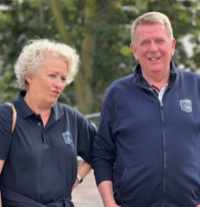
The European Championships are underway in Latvia. As I write this, the pairs events have reached the latter stages. Cathy (pictured right) and Sophia Baldysz went into the 10-pair final of the Women’s Pairs in fourth place. Good luck today, ladies.

I hope to report next month that at least one of the team events has been won by a squad containing one or more panel members. Good luck to all of our panelists in action in Riga.
This month’s guest panelist is the solo winner of the April competition. The runner-up in the 2025 annual competition, Australia’s Alexander Cook has been playing competitive bridge for more than 20 years. He is a versatile bidder, playing four systems with four partners - Standard American, 2-over-1, a strong club variant based on the original Polish Club; and Standard Modern Precision. Alexander is a perennial contender in the Australian Bridge Magazine bidding forum, and he is also a former winner of our annual competition.
A couple of this month’s hands were sent to me. Panelist Larry Cohen contributed Hand 2, and Hand 8 was passed on by David Jones from the UK. Thanks to them. If you have a hand that you think would make an interesting problem for the panel to discuss, please send me the details.
The panel produce a majority vote on four of the hands in this set, and clear favourites on three more. So, this is a relatively easy set, is it? Let’s see…
The most popular action chosen by the competition entrants scores ‘10’ on four of the eight hands, but voting with the largest group of competitors this month scores a lowly 57/80 (down from 67/80 in May). The average score on this set is only 47.24 (well down from 56.54 on Set 26-05). Let’s see what the panel have to say about this month’s hands…
|
ACTION |
MARKS |
PANEL |
Competitors' |
|
3♠ |
10 |
12 |
48 |
|
Pass |
8 |
7 |
15 |
|
4♣ |
5 |
1 |
17 |
|
4♠ |
2 |
0 |
17 |
|
4♥ |
2 |
0 |
1 |
|
3NT |
0 |
0 |
2 |
Competition Entrant Average Score: 7.21
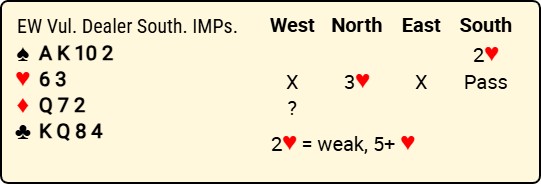
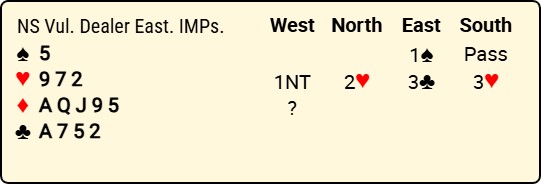
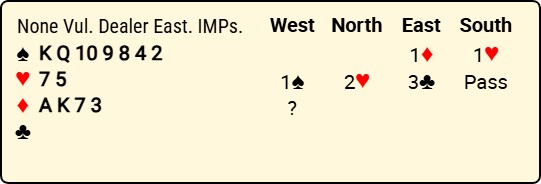
The panel is essentially split between just two choices, and nearly half of competition entrants agree with the majority choice, so a good start to the set for many. Let’s start with the month’s first inaccurate prediction…
ROB BRADY: 4♣. I expect the panel to be split on this one by region: Americans use these doubles as responsive showing both minors, while Europeans tend to like them for uncovering a spade fit. Pass doesn't appeal, but should score some points as we might be collecting +300 with no game making our way.
I am a bit surprised to find that Rob is the lone voice advocating for 4♣, although I am not sure about his regional analysis. As a European, I also play this double as tending to deny four spades, but there were also a few North Americans in the 3♠ camp…
JOEY SILVER: 3♠. After making a vulnerable, under the gun takeout double of 2♥, I think I have bid quite enough on this chunky hand.
BRIAN GLUBOK: 3♠. I'll usually only have four-card length for this action. Partner should amend to 4♣ with 2-2-4-5 or 5-5 in the minors.
SIMON DE WIJS: 3♠. With a normal hand, I will bid my four-card spade suit and see what happens. A lot depends on specific agreements. For me this auction can end in 3♠.
MIGUEL VILLAS-BOAS: 3♠. I don’t have a perfect distribution, but 3♠ looks ok.
MATS NILSLAND: 3♠. Partner's double doesn't promise four clubs.
Zia asks a very valid question.
ZIA MAHMOOD: 3♠. This seems like a strange problem. Is partner supposed to bid spades with something like xxxx/Ax/AKxxx/xx?

Jill offers a more nuanced view for the meaning of the double.
JILL MEYERS: 3♠. I like to play that a responsive double by advancer either shows four spades (invitational or better) OR both minors. If partner has both minors, I don't want to force to the five-level by bidding 4♠, so I will content myself with 3♠.
DAVID BIRD: 3♠. If partner has a good hand, enough for game, he might hold four spades. When in doubt, keep the bidding low.
BARNET SHENKIN: 3♠.
Some have no problem if they end in a Moysian fit…
SALLY BROCK: 3♠. A chunky four-card spades. I will be happy to play in a 4-3 fit if partner so wishes.
ANDREW ROBSON: 3♠. It's a good enough four-card suit to play the 4-3 fit. I might shoot a pass at matchpoints but, even then, it may well be only +100 against a making part-score.
Remarkably, not a single panelist mentions what, for me, is the most compelling reason for choosing 3♠ – “How else might we get to our most likely game? i.e. 3NT”
PIERRE SCHMIDT & JOANNA ZOCHOWSKA: 3♠. We would definitely Pass at matchpoints or BAM. 4♣ sounds forcing, or at least showing a five-card suit (you would not double 2♥ with a minimum hand and less than four spades). 3♠ is not ideal, but at least shows a minimum for my original double.
A couple of panelists have mentioned the main alternative, and the second-largest faction on the panel choose that option with varying degrees of enthusiasm…
LIZ McGOWAN: Pass. Unhappily but, assuming partner is fairly balanced, this looks like our most likely route to a plus score.
PAUL MARSTON: Pass. If partner cannot decide on a suit, I can't either.
Deliriously happy…
LARRY COHEN: Pass. I am leading a trump and issuing the opponents a speeding ticket. I hope.
HANOI RONDON: Pass. And I'll lead a trump. Partner should be fairly balanced for this action, so they may go down quite a bit.
Indeed. When you construct likely hands for partner, this option becomes so much more attractive. How about something like Jx/xxx/AKxx/Axxx? Yes, you will make 5♣ with good breaks in the minors, but how many tricks will 3♥-doubled make on repeated trump leads?
MARTY BERGEN: Pass. I have good defense and an attractive choice of opening leads, against often overly frisky opponents.
CATHY BALDYSZ: Pass.
Alexander seems to knock the problem right on the head.
ALEXANDER COOK: Pass. If we can make 5♣, we should get at least +500 from defending 3♥-doubled. It would be easier to pass at a different vulnerability. I prefer not to bid 3♠ as partner’s responsive double usually denies four spades.
In retrospect, this might have been a better problem had I switched the majors. On this deal from the Chinese Premier League, Christian Bakke knew his side had game values, but there was a chance they had no fit, so he passed and led a trump. East (Boye Brogeland) had xx/Axx/AKxx/Axxx. Accurate defence held declarer to just his four trump winners, so that was +1100. At the other table, 6♣ went down when trumps split 4-1. 3♠ seems likely to get you to 3NT, which has the benefit of nine top tricks, but this is a moral victory for the passers, I think.
|
ACTION |
MARKS |
PANEL |
Competitors' |
|
Rdbl |
10 |
12 |
18 |
|
2♠ |
9 |
5 |
2 |
|
3NT |
7 |
3 |
7 |
|
Pass |
6 |
1 |
5 |
|
3♦ |
4 |
1 |
43 |
|
4♦ |
4 |
0 |
6 |
|
5♦ |
2 |
0 |
5 |
|
2NT |
2 |
0 |
1 |
|
2♦ |
0 |
0 |
8 |
|
2♥ |
0 |
0 |
2 |
|
1NT |
0 |
0 |
1 |
|
3♥ |
0 |
0 |
1 |
Competition Entrant Average Score: 4.85
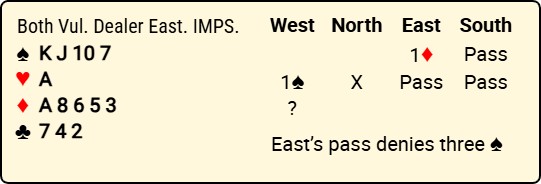
Larry Cohen spotted this unusual situation that arose during the recent US Mixed Teams trials, and it created carnage amongst the competition entrants.
It is rare that you know so much about the unseen hands on the first round of the auction. South is likely marked with ♠Q-x-x-x-x-x and not much else. Partner did not bid 2♣ or 2♦, so he is likely to be balanced. The opponents’ failure to bid hearts makes it likely East has four, so either 2-4-4-3 or 2-4-5-2 shape. North is very likely 1-5-3-4 or 1-5-2-5, and both North and East are probably in the 12-14 range.
Thinking about possible hands for partner quickly reveals the huge potential. With the ♣A marked in the North hand, would you not want to play 6♦ opposite as little as Ax/xxxx/Kxxxx/Kx? Make that ♣K the ace and, with the spade finesse marked to dispose of the club loser, 7♦ needs little more than a 2-1 trump break. It seems to me that our first objective should be to see if we can get partner to rebid his diamonds.
Enough from me. Let’s hear from the panel. Only one was willing to settle for +160/360…
ZIA MAHMOOD: Pass. I think I can make this: partner has something like a 2-4-3-4 weak no-trump. I’ll be interested to see if anyone finds the sexy 2♠ cue bid!
The largest faction on the panel choose to start with a redouble.
MARTY BERGEN: Redbl. I am too strong for a non-forcing 3♦, and there is no good alternative.
MATS NILSLAND: Redbl. I want to see what happens.
CATHY BALDYSZ: Redbl.
Paul earns this set’s ‘Optimist of the Month’ award.
PAUL MARSTON: Redbl. I reckon I can make 1♠. Let's play.
Andrew’s view seems more realistic.
ANDREW ROBSON: Redbl. The oppo won't stick this, so I don't have to worry about whether it's making. The alternative of 3♦ is too much of an underbid. I could bid 2♠, but that's achieving very little other than wasting a level.
Rob offers a slightly different take on what the unseen hands look like.
ROB BRADY: Redbl. We can build a pretty good picture of the hand already. The opponents have at least eight hearts, but South didn't bid 2♥, so the hearts are likely 5-3. South couldn't overcall in spades, but is willing to pass his partner’s double, so he must have something like Qxxxxx/xxx/x/xxx. Partner's most likely shape is 1453, leaving North with 2524. Partner could hold something like x/Q10xx/KQxxx/KQx, when we are making 1♠, possibly with overtricks, but we are also pretty likely to make a game in diamonds, if not a slam... AND redoubling won't be pushing the opponents into a better spot, because 2♥-doubled rates to be +500/800. Redouble should set up a force, and we can go from there when they run.

The British ladies are aiming for 3NT, but want to keep other options open…
LIZ McGOWAN: Redbl. I shall be disappointed if this does not make... I expect LHO will pull to his long suit, and I can cue to see whether partner has opened light. It is tempting just to bid 3NT, but a diamond slam is not out of the question.
SALLY BROCK: Redbl. I would expect to make seven tricks. If we have game on, then simply playing 1♠-doubled won’t score enough. If partner penalty doubles anything they bid, all well and good, otherwise I’ll bid 3NT.
DAVID BIRD: Redbl. I suppose I could bid a 'clever' 2♠. If that was passed out, oh no, I would have to explain to partner that I would pass on the hand that he placed me with. Here, I can show my strength clearly with a redouble and then support diamonds.
MIGUEL VILLAS-BOAS: Redbl. This is the only way to show a strong hand.
Is it? I trust our expert partner to work this out more than David does. And, who can resist the chance to out-sexy Zia? 😊
BARNET SHENKIN: 2♠. This obviously cannot be natural.
HANOI RONDON: 2♠. I couldn't pass up the opportunity to cue-bid in my own suit! Redouble is my second option.
ALEXANDER COOK: 2♠. 2♠ is forcing and, on the next round, I will bid 3♦, which will then be forcing. Passing would be too hairy for my liking.
JOEY SILVER: 2♠. Trying to get a sense of direction.
I think Pierre and Joanna will be happy that their prediction was a long way wide of the mark.
PIERRE SCHMIDT & JOANNA ZOCHOWSKA: 2♠. A good choice to score zero in a bidding challenge, but are we really willing to play 1♠-doubled plus one or two (or down one?), when we can make 3NT, 5♦ or 6♦? We are unsure what partner will understand if we redouble. At least we show a game forcing hand, and we will bid our diamonds next.
A few thought they knew where they were headed, although I think the chances of a diamond slam make this premature.
SIMON DE WIJS: 3NT. I’ve had this situation at the table. An annoying kind of problem. Opposite East’s pass, 3NT must be right. Partner didn’t bid 2♣ or 2♦.
JILL MEYERS: 3NT. My other choice is 2NT, but I have too much (particularly with the diamond fit) to not bid game.
And, the man who knows the hand.
LARRY COHEN: 3NT. It worked so well for Mike Passell, and the more I think about it, the more I like it.
Only Brian is willing to stop out of game.
BRIAN GLUBOK: 3♦. This is a situation I have no familiarity with. If partner has as many as two spades, we might have a strong play or even be a cinch to make 1♠-doubled, but do we really want to play there? Would a redouble be ‘business’, and would he read it that way? And, could he have only one spade? South's penalty pass on this sequence is a rare bird, for he didn't have enough spade length to bid over 1♦, but now he wants to pass out 1♠-doubled? Perhaps he's desperate, and doesn't want to choose between two-card suits, with something like Q9xxx/xx/Jxxx/Jx. (Wouldn’t that give North at least six hearts? MS) I hope there's at least one vote for 2♠, the only cue bid available to us - that's what we'd have to bid with xxxx/A/AQJxx/Axx. On this hand, I am willing to go with 3♦, not quite forcing. I am a little strong for the bid, but only by a jack....
And he could be right, as I did manage to construct a hand for East opposite which 3♦ was the limit: x/KQJx/KQxxx/Jxx.
When the deal occurred in the round robin stage at the U.S. Mixed trials, partner had Ax/10xxx/Q10xx/AQx. South had a 6-4-2-1 shape, so you could make 3NT (losing just 3♥/1♦). At one table, West decided to take his chances here: 1♠-doubled made for +160. It seems likely that the redoublers and the 2♠ bidders will join those who jumped to 3NT in recording +600. 5♦ will also make.
With such a minimum opening bid. partner has no reason to bid again facing a non-forcing jump to 3♦, so that’s a poor end for Brian and the largest group of competition entrants.
|
ACTION |
MARKS |
PANEL |
Competitors' |
|
3NT |
10 |
8 |
38 |
|
4♥ |
9 |
5 |
6 |
|
5♣ |
8 |
4 |
21 |
|
4♣ |
6 |
1 |
23 |
|
4NT |
6 |
1 |
1 |
|
6♣ |
5 |
1 |
2 |
|
6NT |
5 |
0 |
0 |
|
Pass |
2 |
0 |
9 |
Competition Entrant Average Score: 7.74
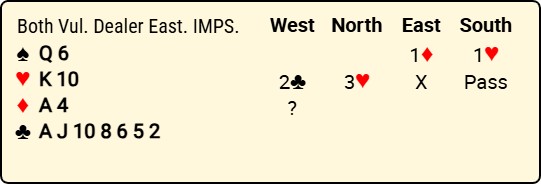
The panel offer six alternatives for this one. There is no majority on the panel, but I see no reason to overrule the weight of votes. However, I do think that the 4♥ and 5♣ bidders have the best of the debate, so everyone choosing one of the panel’s three most popular options scores relatively well.
MATS NILSLAND: 3NT. Hamman's rule.
MIGUEL VILLAS-BOAS: 3NT. The easiest game.
LIZ McGOWAN: 3NT. When in doubt...
ROB BRADY: 3NT. Yes partner, I do have a heart stopper.
MARTY BERGEN: 3NT. I can't say that I'm proud of this.
LARRY COHEN: 3NT. With a guarded king in their suit, when 3NT comes to mind, I can't resist.
Jill offers a logical explanation for her choice.
JILL MEYERS: 3NT. I think partner has extras with long diamonds and he is asking me to do something intelligent. I expect something like AKx/xx/KQJxxx/xx.
DAVID BIRD: 3NT. This is our last chance to play in 3NT. 5♣ might be okay, but partner hasn't ruled out holding a singleton club.
With Jill’s hand the exception, partner holding a singleton club rates to be bad news for either game. With no guarantee of more than one heart stopper, does game in our long suit not look safer opposite a club holding such as K-x, Q-x or Q-x-x?
JOEY SILVER: 5♣. At this level, science goes out the window. East's decision to remain being in action on this auction implies something in clubs, so I am just trying to make a practical bid.
BRIAN GLUBOK: 5♣. I think partner's double of 3♥ should be penalties, but my hand suggests otherwise. I opt for 5♣ rather than 3NT for, opposite Axx/Qx/KQ10xx/Qxx we have better safety in the suit contract. On a deeper probe, it's hard to see what sort of hand partner can have (it would help if I knew how he was defining his double) that's remotely consistent with the bidding. Certainly, the opponents do not have much.
For many, I suspect that double here is one of those “Can you bid 3NT?” requests.
CATHY BALDYSZ: 5♣.
BARNET SHENKIN: 5♣. I would like to bid a forcing 4♣, but it probably isn’t.
Only Sally is willing to go down that road, and her logic is compelling, although whether one would risk it in an unfamiliar partnership is another matter.
SALLY BROCK: 4♣. I am happy that this is forcing (my two-level response and partner’s double, showing extras = game forcing). 3NT could be right, but I do have a lot extra.
If you are committing to clubs, is it not worth making a slam try on the way? If partner’s clubs are as good as K-x-x, do slam prospects not look very bright?
ZIA MAHMOOD: 4♥. I still have slam interest. This suggests long clubs - I would bid 4♣ if I was sure it was forcing, but I’m not.

I cannot argue with Alexander’s reasoning.
ALEXANDER COOK: 4♥. Bidding 4♥ then 5♣ will be a slam invitation. I have more than I have promised and partner’s double shows a better than minimum opening hand.
SIMON DE WIJS: 4♥. Partner is interested in playing 3NT opposite a heart stopper. In that case, I have more than enough extras to try for slam
HANOI RONDON: 4♥. I think 3NT is too little. I prefer to show a stronger hand and take it from there.
PIERRE SCHMIDT & JOANNA ZOCHOWSKA: 4♥. Normally, East's double is three-way: asking for a heart stopper with solid diamonds, or a good hand (unbalanced or 18-19 balanced). 14 HCP and the ♦A in our hand makes it likely that our partner has the good unbalanced hand. We will probably end up playing 6♣ (or 6NT) but we ask for confirmation.
Paul chooses a different route to slam.
PAUL MARSTON: 4NT. I expect partner has a good hand with nothing in hearts. I am heading to slam.
Only Andrew is willing to grasp the nettle now, and his prediction of how good the contract is likely to be is spot on.
ANDREW ROBSON: 6♣. Partner won't be doubling with say, 4-2-6-1 shape: he'll just bid 3♠, so I'm catching at least two clubs, very likely H-x. I may have to guess clubs, but that feels like worst case scenario.
Both West players heard the same auction on this deal from the final of the recent U.S. Open trials. At one table, West jumped to 6♣. Partner had AKxx/x/KJ9xxx/K9. The defence led a heart to South’s ace and a diamond back to the queen and king. However, when declarer predictably failed to pick up North’s ♣Q-x-x, that was one down. At the other table, West advanced with strange-looking 3♠. East rebid 4♦ and they eventually made twelve tricks in 5♦.
I think we’d all agree that we would rather play game in either minor rather than 3NT, so ‘Chapeau’ to the 4♥ and 5♣ bidders.
|
ACTION |
MARKS |
PANEL |
Competitors' |
|
3♣ |
10 |
14 |
24 |
|
3♠ |
7 |
2 |
19 |
|
4♥ |
6 |
2 |
6 |
|
3NT |
4 |
1 |
14 |
|
2NT |
4 |
1 |
2 |
|
4♦ |
2 |
0 |
6 |
|
5♦ |
2 |
0 |
14 |
|
3♦ |
0 |
0 |
6 |
|
4NT |
0 |
0 |
5 |
|
3♥ |
0 |
0 |
3 |
|
4♣ |
0 |
0 |
1 |
|
6♦ |
0 |
0 |
1 |
Competition Entrant Average Score: 5.13
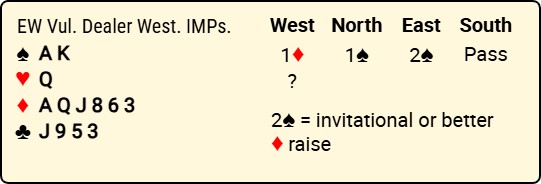
The problem setter usually tries to provide some respite during a set and, for the panel, this was it, with their largest majority vote of the month. Competitors were split much more widely, with nearly a quarter hitting the top spot but the rest scattered over ten alternatives. Let’s start with the only panelist willing to commit to a final destination at this stage of the auction.
PAUL MARSTON: 3NT. My best guess.
The majority saw no reason to guess at this point…
MATS NILSLAND: 3♣. This hand is too good to just bid 3NT.
ZIA MAHMOOD: 3♣. This part is easy…
LIZ McGOWAN: 3♣. Passing the time. Maybe things will become clearer.
JILL MEYERS: 3♣. I want to hear more from partner.
A number want to find out if partner just has a limit raise, or more…
MARTY BERGEN: 3♣. A nice economical forcing bid to learn how strong responder is.
ALEXANDER COOK: 3♣. This leaves the most room to explore the best contract, whether that is 3NT, 5♦ or 6♦. If partner bids 3♦, we will then know that he has only invitational values. With extras, he will bid something else and we will be well placed.
LARRY COHEN: 3♣. I am just getting warmed up. More decisions to follow.
CATHY BALDYSZ: 3♣.
BRIAN GLUBOK: 3♣. Always in a bidding contest, and often in real life, it's best to kick the can down the road with a cue bid. My first (and lazy) inclination was to bid 3♠. But, once you consider the problem a little deeper, you realize that 3♣ is probably better.
DAVID BIRD: 3♣. This gives partner a chance to show a heart stopper with 3♥. This bid may look strange, on J-x-x-x, but it allows us maximum bidding space.
HANOI RONDON: 3♣. We might be heading for 3NT, but 5♦/6♦ are also possibilities. Let’s see what partner has to say next.
SALLY BROCK: 3♣. Let’s see what happens. I have a pretty good hand and maybe we can make slam.
Andrew and our French Mixed pair eloquently sum up the case for the majority.
ANDREW ROBSON: 3♣. I may as well find out whether partner has more than just a limit raise. The trouble with a 4♥ splinter is that it leaves partner with few options, given we have spades controlled. Let's hone in on partner's strength before anything like that.
PIERRE SCHMIDT & JOANNA ZOCHOWSKA:
3♣. We can't show everything with one bid: the double spade stopper, the strength of the hand, the short hearts, the sixth diamond. 4♥ should be understood as a splinter, but we can see ♠A-K in our hand. Partner can't, so he may be stuck for a bid. Let's take the slow route and make a natural bid first.
A couple opt for a 4♥ splinter, but both also point out how their choice may go wrong.
SIMON DE WIJS: 4♥. Let’s try to show my hand. Maybe we belong in 3NT, but I’ll take that chance.
BARNET SHENKIN: 4♥. I accept the danger of club losers. 3♣, looking for 3NT by getting a 3♥ bid from partner, may work better in that event.
If you want to commit, this seems like a better approach, with the option of bidding 4♥ next…
MIGUEL VILLAS-BOAS: 3♠. I am looking for slam. I am not afraid of playing 5♦ if things don’t work out.
ROB BRADY: 3♠. 3♣, 3♠ and 4♥ (splinter) all seem attractive ways to start a slam try. I think our real decision will come on the next round. I rejected 4♥, as partner may picture a 3-1-6-3 shape and be worried if he holds three or four small spades. It feels like a coin flip between the other options. 3♣ highlights the side club suit, but will partner get discouraged later with something like xxxx/Axx/Kxxx/Ax after say 3♣-3♥-3♠-3NT-4♦-? They might think we would just bid keycard if all we needed were three keys. Some slams are just too hard to bid.
Joey makes an assumption that I’m not sure I would risk in an unfamiliar partnership.
JOEY SILVER: 2NT. Surely 2NT is forcing, so I am trying to find out where East wants to take this.
Is this sequence not akin to auctions following an inverted minor-suit raise, as this is the competitive auction equivalent. In those auctions, responder can pass either 3m or 2NT, so I am not sure why he cannot do so here too.
Neither pair managed to reach the top spot on this deal from the match between England and Scotland in the 2026 Lady Milne. The English West jumped to 3NT after this start to the auction. That was not a success when partner produced xx/Jx/K10xxx/A10xx and the defenders cashed the first six tricks in hearts. At the other table, the Scots played in 4♦+1 for an unexpected 8-IMP gain.
This sequence also raises another question for regular partnerships, after 3♣-3♦-? If a 3♠ cue bid would ask for a spade stopper now, implying heart values, 3♥ should presumably show spade values and ask for a heart stop, even though the opponents have not bid that suit. It makes no sense for 3♥ to also ask for a spade stopper.
If you start with 3♠ now, 5♦ seems a likely destination too, whether East bids 4♦ or 5♦ next. Those who splinter with 4♥ might hear 5♣ from partner, but it would still be a stretch to venture beyond game.
|
ACTION |
MARKS |
PANEL |
Competitors' |
|
4♥ |
10 |
12 |
10 |
|
4♦ |
8 |
2 |
6 |
|
4NT |
6 |
2 |
1 |
|
5♣ |
5 |
2 |
34 |
|
Dbl |
5 |
2 |
7 |
|
6♣ |
5 |
0 |
1 |
|
4♣ |
2 |
0 |
35 |
|
Pass |
0 |
0 |
4 |
|
3NT |
0 |
0 |
1 |
|
5♦ |
0 |
0 |
1 |
Competition Entrant Average Score: 4.34
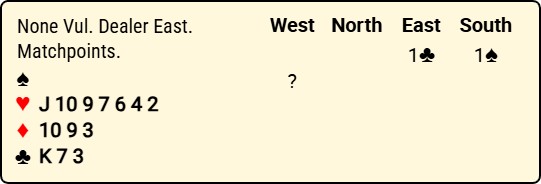
What a contrast. Most panel members are looking for slam. However, there are two large groups of competitors, each with about a third of the votes: one bids game and the other is willing to settle for a partscore! The result is the third low-scoring hand for competitors in the set so far.
We start with two panelists who seem to have diametrically opposed views of what their action means…
MARTY BERGEN: Dbl. If partner has two hearts, I'm happy to defend.
ANDREW ROBSON: Dbl. I make the cheapest call to glean more information. (It is obviously not for penalties.) Second choice is 4♥, but that can come later. I do fancy partner for a void heart, though, as the adverse vulnerable opponents are doing an awful lot of bidding with slender values. We're very likely heading for 6♣, but we could easily be on for seven.
The majority choice is to cue bid partner’s control for him…
ZIA MAHMOOD: 4♥. What else?
MIGUEL VILLAS-BOAS: 4♥. Showing strong support for clubs.
PAUL MARSTON: 4♥. A general slam try in clubs.
JILL MEYERS: 4♥. This has to be interest in clubs. Over 4♠, I will just bid 5♣.
ALEXANDER COOK: 4♥. This is a cue bid agreeing clubs. 5♣ would be premature. Partner is short in hearts and we do not need much to make slam.
SALLY BROCK: 4♥. Hopefully, they have at least nine hearts. I don’t think I can really just jump to 6♣, because there could easily be two aces missing. (Partner would surely bid 3♣ with most 5-5 shapes).
Larry provides an East hand that will need some encouragement.
LARRY COHEN: 4♥. I could settle for 5♣, but I love this hand enough to make a stronger call. Picture partner with as little as AJxxx/x/Kx/KQxxx. Slam is cold, but he would never move if I just bid 5♣ now.
DAVID BIRD: 4♥. It should be safe to cue bid in hearts, as partner is very likely to have a singleton there. 4♣ would be non-forcing, so unthinkable, and even 5♣ is a slight underbid.
There was only one complaint about our previous bidding.
PIERRE SCHMIDT & JOANNA ZOCHOWSKA: 4♥. We see no other way to show our enthusiasm. We would have bid 2♦ (yes, game forcing) instead of 1NT.
Brian introduces a general principle that makes a lot of sense.
BRIAN GLUBOK: 4♥. I'm trying for 6♣, and cue bidding partner's (potential) heart control. Jumping to 5♣ is fine, but not quite enough with this great hand - and 6♣, that's too much. A grand slam would be excellent opposite as little as AQ10xx/void/Kxx/KQxxx. Not that I want to get to seven, but I sometimes use that as an indicator. If we could easily be cold for seven, that provides a compelling reason to try harder to look for six.
SIMON DE WIJS: 4♥. I have faith in my opponents at this vulnerability (that they have at least nine hearts). My hand is exceptional for clubs, so let’s see if partner knows what to do next.
Rob mentions the other serious alternative.
ROB BRADY: 4♥. We all agree that 4♦ is a fit-showing non-jump, right? I'm not going to chance that. 4♥ sends a clear picture that we are maximum with a club fit.
A couple of panelists do go down that road.
HANOI RONDON: 4♦. This should be a cue bid agreeing clubs, as we could double to show diamonds. This avoids making a 4♥ cue bid without a control in the suit.
BARNET SHENKIN: 4♦. Over 4♥, I will bid 6♣.
Regular partnerships should discuss and agree the meaning of 4NT in this type of auction.
JOEY SILVER: 4NT. This CANNOT be Blackwood, so it shows a good raise to 5♣.
MATS NILSLAND: 4NT. If we don't have an agreement, partner may take 4♥ as showing a control. I hope he understands 4NT as a good 5♣ bid without a heart control.
Only a couple of panelists are willing to settle for game.
LIZ McGOWAN: 5♣. This might even make.
CATHY BALDYSZ: 5♣.
At the table, partner had AK10xxx/---/10x/QJ10xx, so 6♣ was an excellent spot.
|
ACTION |
MARKS |
PANEL |
Competitors' |
|
3♥ |
10 |
8 |
38 |
|
4♥ |
9 |
6 |
13 |
|
Pass |
6 |
4 |
16 |
|
Dbl |
5 |
1 |
11 |
|
2♥ |
4 |
1 |
18 |
|
2♣ |
0 |
0 |
1 |
Competition Entrant Average Score: 7.20
First, an apology to those competition entrants who looked at the system notes and saw that “All jumps below game in a competitive auction are fit-showing.” Unfortunately, many panel members (and over two-thirds of competitors) did not do so, and simply assumed that 3♥ was natural and weak. However, with the pre-empters far outnumbering those preferring a less adventurous approach, the panel’s intention seems clear, hence the marking.
MATS NILSLAND: Pass. Trying to show this hand directly is too difficult. I prefer to listen to the others at this point.
DAVID BIRD: Pass. No heart bid seems to fit well. In particular, I would not like to mislead partner by bidding 4♥ on such a weak suit.
CATHY BALDYSZ: Pass.
LIZ McGOWAN: Pass. I shall get another chance to bid without telling partner that I have non-existent values
Yes, probably when North’s raise to 4♠ comes back to you.
ROB BRADY: Dbl. 3♥ is a fit-showing jump according to the system notes, so it seems our choices are to gamble with 4♥ or to go low with a negative double. Pass looks awful with a spade pre-empt coming on our left. At IMPs I have much more sympathy for 4♥.
The problem with both Rob’s double and Paul’s 2♥ is that partner will expect some values. That may mean that it is more likely to go 4♠-Dbl-Pass-? back to you rather than 4♠-Pass-Pass-?
PAUL MARSTON: 2♥. Not 4♥. I want to hear what's going on. OK, I'm a control freak.
The rest all opt for pre-emption…
ZIA MAHMOOD: 3♥. If this is what I think it is...
It’s not, but you are not alone in thinking it might be.
MIGUEL VILLAS-BOAS: 3♥. A weak hand with seven hearts.
JILL MEYERS: 3♥. Pre-emptive with long hearts.
SIMON DE WIJS: 3♥. This feels normal. What else?
LARRY COHEN: 3♥. No footnote by the problem setter, so I am assuming this is weak -- and feels about right.
SALLY BROCK: 3♥. I play this is a pre-empt after a 1♣ opening only (I don’t know what the system here is exactly). I want to put them under maximum pressure.
BARNET SHENKIN: 3♥.
PIERRE SCHMIDT & JOANNA ZOCHOWSKA: 3♥. Pre-empt (as you can see!) This hand is sub-minimum, of course, but we want to be in before the tray comes back with many spades.
Will a pre-emptive jump to 3♥ be enough to spur partner into action at the five-level? The next group think not…
MARTY BERGEN: 4♥. This is my best chance of persuading partner to do the right thing when North bids 4♠.
ALEXANDER COOK: 4♥. The practical bid. North will probably "accept the transfer" by bidding 4♠, but now we have accurately described our hand and partner can judge whether to bid 5♥ or not. If I pass or double, I will have trouble convincing partner that I have this hand. Another option for me would be 3♥, as I do not play fit-showing jumps.
I agree with Andrew’s analysis of this situation.
ANDREW ROBSON: 4♥. It's 3♥ or 4♥, but 3♥ is probably a waste of time given that North has a bushel of spades waiting to reveal. Let's make him do so at a high level. The other advantage of 4♥ is that it shows the offense and may enable pard to save (or make, one can dream) in 5♥ over 4♠.

JOEY SILVER: 4♥. Hopefully, partner won't take me too seriously.
BRIAN GLUBOK: 4♥. I don't love it, but I like pass even less. If 3♥ is weak, or 2♥ non-forcing, I like either of those two. The negative double I didn't think of, and I'm not really thinking of it now....
HANOI RONDON: 4♥. I think this is the right bid with this collection. They have at least nine spades, but our jump may deter them from getting to 4♠. Or, they might also get there when it isn't making.
Surprisingly, perhaps, this deal belonged to our side. Not that partner’s hand was anything remarkable. He had Axx/xx/Kxx/AQxxx and, with hearts 2-2 and the ♦A onside, you can make 4♥. Opponents have a cheap save in 4♠, but the objective on this deal was not to allow them to buy the hand in something they can make. If you bid 3♥ and North bids 3♠, is anyone bidding again? I suspect not.
|
ACTION |
MARKS |
PANEL |
Competitors' |
|
3♥ |
10 |
8 |
23 |
|
4♠ |
7 |
6 |
39 |
|
4♦ |
7 |
5 |
9 |
|
4♣ |
5 |
1 |
1 |
|
5♦ |
2 |
0 |
7 |
|
3♠ |
0 |
0 |
14 |
|
3♦ |
0 |
0 |
5 |
|
4NT |
0 |
0 |
1 |
Competition Entrant Average Score: 5.71
The panel is essentially split between three choices, although I think the most popular answer also wins the debate, hence the marking. Let’s start with those panelists who follow the mantra of ‘support with support’…
DAVID BIRD: 4♦. This shows my splendid diamond support, which is a more pressing need than showing extra spades. At matchpoints, I would bid differently.
HANOI RONDON: 4♦. This sets diamonds as trump, and we will find out if partner has a heart control.
SIMON DE WIJS: 4♦. On a bad day, 4♠ is the only making game. Let’s hope today’s not a bad day.
BARNET SHENKIN: 4♦.
ZIA MAHMOOD: 4♦. Luckily, this is not some key card ask.
At the other end of the scale, are those panelists who support the choice of more than a third of competition entrants…
ANDREW ROBSON: 4♠. There is a big danger of losing three tricks in 5♦, e.g. facing something like J/xx/QJ10xx/AKQxx.
Is partner supposed to overrule you with something like void/Ax/QJxxxx/AKQxx?
PIERRE SCHMIDT & JOANNA ZOCHOWSKA: 4♠. Nowadays, you don't bid 1♠ with this hand, but 2♥, showing 6+♠, weak or game forcing (and 3♥ would show six spades invitational). That would have solved our problem. A nebulous cue or a strong diamond bid (4♦) now will make it too difficult to stop in 4♠, facing a shortness in this suit.
I think a large percentage of the world’s players still start with 1♠.
JOEY SILVER: 4♠. Trying to be true to my nature, I make what I consider the practical bid.
Is there not also the danger that game in spades is not enough?
SALLY BROCK: 4♠. This hand is much too good for this really, but it is not clear what else I can bid. Partner does not need a lot to bid 3♣.
I think most would agree with both of Marty’s observations.
MARTY BERGEN: 4♠. This is definitely an underbid, but I don't think that 3♠ would be forcing.
BRIAN GLUBOK: 4♠. This is a tough one, and we could easily be missing 6♦. I'm guessing that this is our safest game. A cue bid on the way is fine too, I just don't like that style (interesting problems on that theme have come up several times this month).
Andrew has already pointed out the flaw with supporting diamonds immediately, so, what is the alternative?
PAUL MARSTON: 3♥. Very tricky.
LIZ McGOWAN: 3♥. Let’s make a forcing noise and postpone the guess until the next round. Perhaps partner will tell us something useful.
ALEXANDER COOK: 3♥. Another cue bid. We will see if partner has spade support (e.g. a doubleton). If he doesn't, I can then bid a forcing 4♦ and investigate further.
MIGUEL VILLAS-BOAS: 3♥. Let’s start by creating a force, then I can support diamonds on the next round.
LARRY COHEN: 3♥. As I tell my students, this 3♥ bid can be many things. The only thing for sure is "it is forcing."
ROB BRADY: 3♥. Although this hand is a perfect 3♠ bid over 1♥ to show a game-forcing fit jump, I'm glad we didn't force partner to remember our agreements. Having gotten here, 3♥ is the most flexible way to establish the game force and allow partner to bid 3♠ with a doubleton. I'll continue with 4♦ over 3NT, and be a bit sad if partner turns up with J/QJx/Qxxxx/AKxx.
I think this hand is too spadey for a fit-jump. There is a lot of difference between this hand and something like KQ10xx/x/AKxx/Qxx. With this hand, I may want to play 4♠ (or even 6♠) opposite something like stiff ace or jack or J-x. If I start with a fit-jump, partner will surely insist on diamonds with those holdings.
CATHY BALDYSZ: 3♥.
MATS NILSLAND: 3♥. My alternative is 4♦.
Jill is flying solo with her alternative method of waiting…
JILL MEYERS: 4♣. If partner bids 4♦, I will continue with 4♠. If he bids 4♥, I will still be thinking.
Note to almost 20% of competitors: Neither 3♦ nor 3♠ are forcing, so those are not options on this good hand. At the table, partner had void/AKx/QJxxx/KQxxx, so 6♦ was a good spot. (Indeed, with South holding the singleton ♠J, both 7♦ and 6♠ make.)
|
ACTION |
MARKS |
PANEL |
Competitors' |
|
6♦ |
10 |
8 |
18 |
|
6NT |
9 |
5 |
5 |
|
5NT |
7 |
0 |
1 |
|
4NT |
6 |
3 |
13 |
|
4♠ |
6 |
1 |
8 |
|
3NT |
4 |
3 |
18 |
|
5♦ |
4 |
0 |
19 |
|
4♦ |
0 |
0 |
17 |
|
Pass |
0 |
0 |
2 |
Competition Entrant Average Score: 5.06
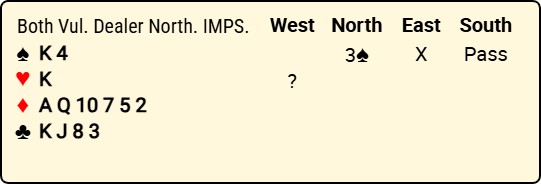
I thought this was probably the toughest problem of the set, and it certainly proved to be another difficult one for the competitors. A significant number were even willing to play in a partscore (4♦), and many settled for game in either diamonds or no-trumps. Meanwhile, two thirds of the panel commit to slam in one of those denominations. Let’s start with the pessimists…
PAUL MARSTON: 3NT. I am only thinking about my safest game. I see no sensible pathway to slam.
LIZ McGOWAN: 3NT. There could be a slam, but I see no clear route to find it.
MIGUEL VILLAS-BOAS: 3NT. With the ♠K, it looks normal to bid no-trumps.
Yes, but at what level? Jill and Marty think it is worth a slam try…
JILL MEYERS: 4NT. I hope partner interprets this as natural.
MARTY BERGEN: 4NT. Natural and invitational. This is possibly an underbid, but I don't love the alternatives.
Although not all were of the same opinion.
SIMON DE WIJS: 4NT. I will show minors and correct 5♣ to 5♦. At the very least this sounds intelligent.
Mats highlights one key point of the hand, and then chooses a bid that makes it harder for him to meet his stated objective.
MATS NILSLAND: 4♠. I want to declare this hand.
The rest all simply commit to slam, although some not exactly wholeheartedly…
BARNET SHENKIN: 6♦. I like 3NT playing rubber bridge. I’d bid 4NT if it was quantitative, but I think most play it as showing minors, and 5NT is pick a slam, so options are limited.
SALLY BROCK: 6♦. There comes a time! Fingers crossed.
BRIAN GLUBOK: 6♦. We're missing four key cards, but partner figures to have at least three of them.
LARRY COHEN: 6♦. I am hoping for three key cards, which seems likely given partner's vulnerable entry at this high level. If I knew partner wouldn't bid diamonds over 4♠, I'd try that to start (followed by 5♦), but it may be essential to protect my ♠K. Imagine partner with something like xx/AQxx/KJxxx/AQ.
ZIA MAHMOOD: 6♦. I am embarrassed by my own bad bidding, although I would like to hear how to give partner a choice and still protect the ♠K.
That is indeed the dilemma, Zia, and the panel seem to have answered your question – you can’t!
HANOI RONDON: 6♦. I have a great hand, but I want to right-side the contract to protect the ♠K.
CATHY BALDYSZ: 6♦.
DAVID BIRD: 6♦. I don't want to ask partner to choose a minor. I suppose I might, if the minors were the other way round (and I didn't need to protect the ♠K from the lead).
The second faction come up with the same answer but in an alternative denomination.
ROB BRADY: 6NT. I dare you to show me a hand where this contract doesn't make. I am trying to protect against hands like xxx/AQJx/Kxx/AQx, where 6♦ goes down on a spade ruff.
JOEY SILVER: 6NT. No guarantees, but I am protecting my spade holding (including from an adverse ruff), which in my eyes is the practical choice.

ALEXANDER COOK: 6NT. This is not very scientific, but all other bids have flaws (4♠, 4NT, 5NT, etc). We do not want partner to be declarer if he does not have the ♠A.
Andrew comes up with three good reasons for preferring this option.
ANDREW ROBSON: 6NT. The advantages of 6NT over 6♦: the danger of an immediate ruff is averted, it will give me more flexibility in order of playing suits (as no ruff), and 3 IMPs more when they both make.
PIERRE SCHMIDT & JOANNA ZOCHOWSKA: 6NT. We will end up there, and we are exhausted by this set, so time for a drink.
Amen to that!
There are questions for regular partnerships to discuss here. Does 4♠ suggest hearts? Is 4NT natural or minors (or any two suits)?
The minor-suit disparity here makes both 4NT (if it shows minors) and 5NT (pick a slam) unattractive and, as many panelists observed, protecting the ♠K makes inviting partner choose a denomination a non-starter.
On this deal from a quarter-final match in the English Seniors Knockout, partner had A/A109x/KJx/AQxxx so, with four key cards, he will certainly raise a jump to 6♦ to the cold grand. Similarly, 6NT which, as Andrew pointed out, brings in 3 IMPs.
A natural 4NT rates to get raised to 6NT, and partner probably tries 5NT over 4♠, but the grand is never really in the frame after either of those starts. Will 3NT end the auction right there? Perhaps, and that would certainly be embarrassing. A clear win for those choosing either 6♦ or 6NT.
After the May set, on which 23 competition entrants outscored the entire panel, we have another on which a few also rate to do so. This month’s panel is led by America’s favourite bridge teacher, Larry Cohen, with a score of 75/80. Just behind him, we have a tie for second place between France’s leading Mixed pair, Pierre Schmidt & Joanna Zochowska, and our guest panelist, Australia’s Alexander Cook, both with 74/80.
Good luck to all those panelists who are in Latvia, contesting the European Championships. I hope to report next month that one or more of the titles has been won by teams including panel members.
Thanks to all of our panelists. See you again next month. Marc
|
Larry COHEN |
Pass |
3NT |
3NT |
3♣ |
4♥ |
3♥ |
3♥ |
6♦ |
75 |
|
Alexander COOK |
Pass |
2♠ |
4♥ |
3♣ |
4♥ |
4♥ |
3♥ |
6NT |
74 |
|
Pierre SCHMIDT & Joanna ZOCHOWSKA |
3♠ |
2♠ |
4♥ |
3♣ |
4♥ |
3♥ |
4♠ |
6NT |
74 |
|
David BIRD |
3♠ |
Rdbl |
3NT |
3♣ |
4♥ |
Pass |
4♦ |
6♦ |
73 |
|
Sally BROCK |
3♠ |
Rdbl |
4♣ |
3♣ |
4♥ |
3♥ |
4♠ |
6♦ |
73 |
|
Zia MAHMOOD |
3♠ |
Pass |
4♥ |
3♣ |
4♥ |
3♥ |
4♦ |
6♦ |
72 |
|
Miguel VILLAS-BOAS |
3♠ |
Rdbl |
3NT |
3♠ |
4♥ |
3♥ |
3♥ |
3NT |
71 |
|
Hani RONDON |
Pass |
2♠ |
4♥ |
3♣ |
4♦ |
4♥ |
4♦ |
6♦ |
70 |
|
Brian GLUBOK |
3♠ |
3♦ |
5♣ |
3♣ |
4♥ |
4♥ |
4♠ |
6♦ |
68 |
|
Jill MEYERS |
3♠ |
3NT |
3NT |
3♣ |
4♥ |
3♥ |
4♣ |
4NT |
68 |
|
Mats NILSLAND |
3♠ |
Rdbl |
3NT |
3♣ |
4NT |
Pass |
3♥ |
4♠ |
68 |
|
Barnet SHENKIN |
3♠ |
2♠ |
5♣ |
4♥ |
4♦ |
3♥ |
4♦ |
6♦ |
68 |
|
Cathy BALDYSZ |
Pass |
Rdbl |
5♣ |
3♣ |
5♣ |
Pass |
3♥ |
6♦ |
67 |
|
Rob BRADY |
4♣ |
Rdbl |
3NT |
3♠ |
4♥ |
Dbl |
3♥ |
6NT |
66 |
|
Marty BERGEN |
Pass |
Rdbl |
3NT |
3♣ |
Dbl |
4♥ |
4♠ |
4NT |
65 |
|
Simon DE WIJS |
3♠ |
3NT |
4♥ |
4♥ |
4♥ |
3♥ |
4♦ |
4NT |
65 |
|
Andrew ROBSON |
3♠ |
Rdbl |
6♣ |
3♣ |
Dbl |
4♥ |
4♠ |
6NT |
65 |
|
Liz McGOWAN |
Pass |
Rdbl |
3NT |
3♣ |
5♣ |
Pass |
3♥ |
3NT |
63 |
|
Joey SILVER |
3♠ |
2♠ |
5♣ |
2NT |
4NT |
4♥ |
4♠ |
6NT |
62 |
|
Paul MARSTON |
Pass |
Rdbl |
4NT |
3NT |
4♥ |
2♥ |
3♥ |
3NT |
56 |
|
|
|
|
|
|
|
|
|
|
|
|
TOP SCORE |
3♠ |
Rdb |
3NT |
3♣ |
4♥ |
3♥ |
3♥ |
6♦ |
|
|
HAND 1: |
3♠ 10 |
Pass 8 |
4♣ 5 |
4♥/4♠ 2 |
|
|
|
HAND 2: |
Rble 10 |
2♠ 9 |
3NT 7 |
Pass 6 |
3♦/4♦ 4 |
2NT/5♦ 2 |
|
HAND 3: |
3NT 10 |
4♥ 9 |
5♣ 8 |
4♣/4NT 6 |
6♣/6NT 5 |
Pass 2 |
|
HAND 4: |
3♣ 10 |
3♠ 7 |
4♥ 6 |
2NT/3NT 4 |
4♦/5♦ 2 |
|
|
HAND 5: |
4♥ 10 |
4♦ 8 |
4NT 6 |
5♣/6♣/Dbl 5 |
4♣ 2 |
|
|
HAND 6: |
3♥ 10 |
4♥ 9 |
Pass 6 |
Dbl 5 |
2♥ 4 |
|
|
HAND 7: |
3♥ 10 |
4♦/4♠ 7 |
4♣ 5 |
5♦ 2 |
|
|
|
HAND 8: |
6♦ 10 |
6NT 9 |
5NT 7 |
4♠/4NT 6 |
3NT/5♦ 4 |
|
|
HAND 1: |
7.21 |
|
HAND 2: |
4.85 |
|
HAND 3: |
7.74 |
|
HAND 4: |
5.13 |
|
HAND 5: |
4.34 |
|
HAND 6: |
7.20 |
|
HAND 7: |
5.71 |
|
HAND 8: |
5.06 |

